Thursday, December 2, 2004


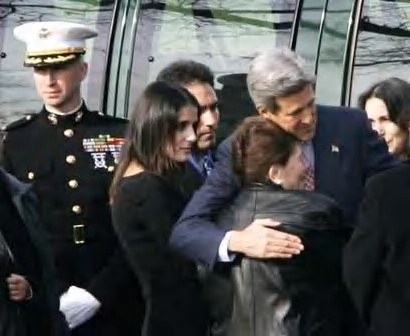
Former U.S. presidential candidate, Senator John Kerry (news - web sites) (D-MA) hugs an unidentified member of U.S. Marine Lance Cpl. Dimitrios Gavriel's family during his military funeral at Arlington National Cemetery near Washington DC, December 2, 2004. Gavriel, from Haverhill, Massachusetts, died November 19 while fighting in Al Anbar Province in Iraq (news - web sites), and his funeral was the 99th 'Operation Iraqi Freedom' funeral at Arlington National Cemetery. REUTERS/Jason Reed

Posted by Hello

Read more

Penelope Gavriel (bottom L) kisses the U.S. flag that draped the casket of her son, Lance Cpl. Dimitrios Gavriel, as U.S. Senators' Ted Kennedy (2nd-L), D-MA, and John Kerry (news - web sites) ®, D-MA, stand alongside other family members during his honor guard funeral at Arlington National Cemetery near Washington DC, December 2, 2004. Gavriel, from Haverhill, Massachusetts, died November 19 while fighting in Al Anbar Province in Iraq (news - web sites). REUTERS/Jason Reed REUTERS
 Posted by Hello
Read more

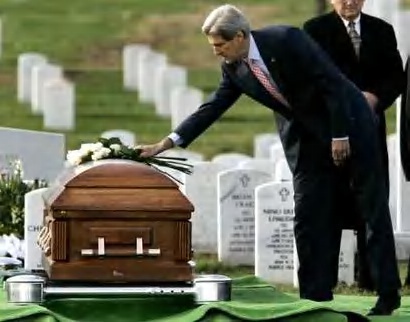
Former U.S. presidential candidate, Senator John Kerry (news - web sites) (D-MA), lays flowers on the casket of U.S. Marine Lance Cpl. Dimitrios Gavriel during his military funeral at Arlington National Cemetery near Washington DC, December 2, 2004. Gavriel, from Haverhill, Massachusetts, died November 19 while fighting in Al Anbar Province in Iraq (news - web sites) and his funeral is the 99th 'Operation Iraqi Freedom' funeral at Arlington National Cemetery. REUTERS/Jason Reed
 Posted by Hello
Read more

Bree, you might want to download this emblem.  Posted by Hello
Read more

Welcome, another co-author, Bree

Welcome Bree, our blog here at Wonderwander, hasn't seen much action of late. As a co-author, you can post photos here using the Hello gadget, it works really well for me. And you can put original posts here, too, telling us about life in Germany.

Read more

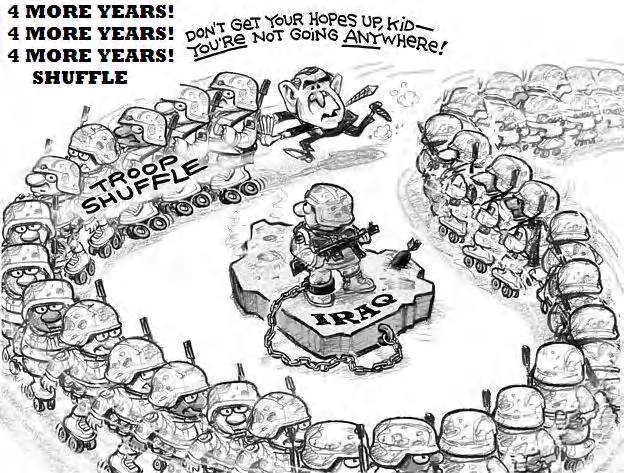
Bush policy in Iraq...never ending war, recycling the same troops over and over and over again. Wondering when those who voted Bush this time will be signing up or sending their kids to do their patriotic part in Iraq. Not really, I want no more carnage of humans in Iraq....but will never, ever understand how people could Vote For War, Killing, Maiming and Death for our young
 Posted by Hello
Read more

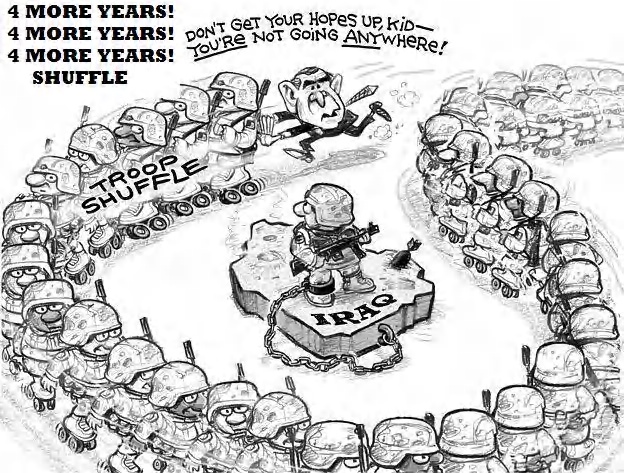
Bush policy in Iraq...never ending war, recycling the same troops over and over and over again. Wondering when those who voted Bush this time will be signing up or sending their kids to do their patriotic part in Iraq. Not really, I want no more carnage of humans in Iraq....but will never, ever understand how people could Vote For War, Killing, Maiming and Death for our young
 Posted by Hello
Read more

Friday, November 5, 2004

I feel like voters just signed the death warrant for our kids

It is over, the elections, and apparantly the Voice of America has spoken. We are stunned, in shock and awe, in a most literal sense. We cannot believe what we have just seen happen in our country.We will likely never forget the image map of red states to blue in this election.


Well, I guess we belong in the blue state where we reside and guess there are very few blue states left in this great country. Blue lined up along the west coast and the northern states of the east coast and a few of the Great Lake states. We comprise the perimeter of the country, I guess, and no place else to go but the oceans.


It is now post-election and the ground truth is that there will be 4 more years of Bush and his administration ... unleashed, unchained. We look for and anticipate the literal blood bath that will ensue and while I have had 2 1/2 years now to protest the war while supporting the needs of the troops, there was a degree of comfort that much of our country felt the same. There was a degree of comfort that Bush was thrust upon us in a bad election debacle in 2000, and that could be "righted" with this election.


The Voice of America has said otherwise. I do not know how to "be" just now as an American citizen out of harmony with my own country. I do not know how to explain to our young when they ask me literally, as they have after this election, "what happened to America". I do not know how to respond to our young soldier who says to me after the election "Mom, you know what this means don't you...there will be a blood bath"... to which I can only say "yes, I know....."


I don't know how to reconcile the definitions now that define christian as it seems to have taken on a morality tone of anti-abortion and anti-gay as if that was the entire message of the christian faith. How did the voters who voted morality and faith overlook the first commandment, Thou shalt not kill....? How did the voters reconcile the aborted life of the young troops who have not yet tasted adult life How did christians not separate morality from ethics? Anyway, a discussion for another day...I have no heart for it now.


I'll get my strength back, I'm sure, but I don't know how to depersonalize this election among my country. I feel like voters just signed the death warrant for our kids and I have to find a way within myself to reconcile my feelings with regard to knowing about half of the country voted for Bush. I don't know how to interpret that as other than our country agreeing to the consignment of our children to war, and why? How utterly selfish to put their "fears" above the well-being of the young generation for which us elders have stewardship. But I know I must find a way to reconcile it within myself. It was never just politics for us...we really did feel we were fighting for our country, for our kids.


So, with the ground truth now being that Bush remains the CIC, I will continue in my work as part of the organization Military Families Speak Out (MFSO..http://www.mfso.org/) which has now a membership of close to 2000 military families. It is a non-partisan, non-political organization with one message..Support our Troops. The difference is that it is not a Hooah message as heard from many military families, but one that supports the dignity, honor, ideals, courage and valor of the troops on the ground.


A message that the American people need to do more for our troops and demand more for our troops than to just tell them thank you ... that is not enough. The troops need more, they need all of us now more than ever and they need us to work on the homefront on their behalf, wisely, thoughtfully, intelligently and demand of the administration (no matter who occupies the office) the needs of our troops cannot be explained away as oversights and mismanagement. The needs of our troops are real and deadly and being so poorly managed leaving the troops exposed to danger above and beyond their call to duty. Our CIC owes the troops more..we will demand it.


American Soldier...be well, keep you courage and wits about you in the days ahead.


A proud military family of Iraq veterans,

An old military brat,

A Vietnam era military wife,


Don't even think about challenging my patriotism, it is deeper than platitudes as is my love for the troops and what they represent, what they stand for, what they commit themselves to....as is my love for their families that stand in courage behind the troops.


signing myself; Duty Calls..on the homefront.


Courage doesn't always shout. Sometimes courage is the quiet voiceat the end of the day that says, "I will try again tomorrow."


Read more
I feel like voters just signed the death warrant for our kids

It is over, the elections, and apparantly the Voice of America has spoken. We are stunned, in shock and awe, in a most literal sense. We cannot believe what we have just seen happen in our country.We will likely never forget the image map of red states to blue in this election.


Well, I guess we belong in the blue state where we reside and guess there are very few blue states left in this great country. Blue lined up along the west coast and the northern states of the east coast and a few of the Great Lake states. We comprise the perimeter of the country, I guess, and no place else to go but the oceans.


It is now post-election and the ground truth is that there will be 4 more years of Bush and his administration ... unleashed, unchained. We look for and anticipate the literal blood bath that will ensue and while I have had 2 1/2 years now to protest the war while supporting the needs of the troops, there was a degree of comfort that much of our country felt the same. There was a degree of comfort that Bush was thrust upon us in a bad election debacle in 2000, and that could be "righted" with this election.


The Voice of America has said otherwise. I do not know how to "be" just now as an American citizen out of harmony with my own country. I do not know how to explain to our young when they ask me literally, as they have after this election, "what happened to America". I do not know how to respond to our young soldier who says to me after the election "Mom, you know what this means don't you...there will be a blood bath"... to which I can only say "yes, I know....."


I don't know how to reconcile the definitions now that define christian as it seems to have taken on a morality tone of anti-abortion and anti-gay as if that was the entire message of the christian faith. How did the voters who voted morality and faith overlook the first commandment, Thou shalt not kill....? How did the voters reconcile the aborted life of the young troops who have not yet tasted adult life How did christians not separate morality from ethics? Anyway, a discussion for another day...I have no heart for it now.


I'll get my strength back, I'm sure, but I don't know how to depersonalize this election among my country. I feel like voters just signed the death warrant for our kids and I have to find a way within myself to reconcile my feelings with regard to knowing about half of the country voted for Bush. I don't know how to interpret that as other than our country agreeing to the consignment of our children to war, and why? How utterly selfish to put their "fears" above the well-being of the young generation for which us elders have stewardship. But I know I must find a way to reconcile it within myself. It was never just politics for us...we really did feel we were fighting for our country, for our kids.


So, with the ground truth now being that Bush remains the CIC, I will continue in my work as part of the organization Military Families Speak Out (MFSO..http://www.mfso.org/) which has now a membership of close to 2000 military families. It is a non-partisan, non-political organization with one message..Support our Troops. The difference is that it is not a Hooah message as heard from many military families, but one that supports the dignity, honor, ideals, courage and valor of the troops on the ground.


A message that the American people need to do more for our troops and demand more for our troops than to just tell them thank you ... that is not enough. The troops need more, they need all of us now more than ever and they need us to work on the homefront on their behalf, wisely, thoughtfully, intelligently and demand of the administration (no matter who occupies the office) the needs of our troops cannot be explained away as oversights and mismanagement. The needs of our troops are real and deadly and being so poorly managed leaving the troops exposed to danger above and beyond their call to duty. Our CIC owes the troops more..we will demand it.


American Soldier...be well, keep you courage and wits about you in the days ahead.


A proud military family of Iraq veterans,

An old military brat,

A Vietnam era military wife,


Don't even think about challenging my patriotism, it is deeper than platitudes as is my love for the troops and what they represent, what they stand for, what they commit themselves to....as is my love for their families that stand in courage behind the troops.


signing myself; Duty Calls..on the homefront.


Courage doesn't always shout. Sometimes courage is the quiet voiceat the end of the day that says, "I will try again tomorrow."

Read more
It is over, the elections, and apparantly the Voice of America has spoken. We are stunned, in shock and awe, in a most literal sense. We cannot believe what we have just seen happen in our country.We will likely never forget the image map of red states to blue in this election.


Well, I guess we belong in the blue state where we reside and guess there are very few blue states left in this great country. Blue lined up along the west coast and the northern states of the east coast and a few of the Great Lake states. We comprise the perimeter of the country, I guess, and no place else to go but the oceans.


It is now post-election and the ground truth is that there will be 4 more years of Bush and his administration ... unleashed, unchained. We look for and anticipate the literal blood bath that will ensue and while I have had 2 1/2 years now to protest the war while supporting the needs of the troops, there was a degree of comfort that much of our country felt the same. There was a degree of comfort that Bush was thrust upon us in a bad election debacle in 2000, and that could be "righted" with this election.


The Voice of America has said otherwise. I do not know how to "be" just now as an American citizen out of harmony with my own country. I do not know how to explain to our young when they ask me literally, as they have after this election, "what happened to America". I do not know how to respond to our young soldier who says to me after the election "Mom, you know what this means don't you...there will be a blood bath"... to which I can only say "yes, I know....."


I don't know how to reconcile the definitions now that define christian as it seems to have taken on a morality tone of anti-abortion and anti-gay as if that was the entire message of the christian faith. How did the voters who voted morality and faith overlook the first commandment, Thou shalt not kill....? How did the voters reconcile the aborted life of the young troops who have not yet tasted adult life How did christians not separate morality from ethics? Anyway, a discussion for another day...I have no heart for it now.


I'll get my strength back, I'm sure, but I don't know how to depersonalize this election among my country. I feel like voters just signed the death warrant for our kids and I have to find a way within myself to reconcile my feelings with regard to knowing about half of the country voted for Bush. I don't know how to interpret that as other than our country agreeing to the consignment of our children to war, and why? How utterly selfish to put their "fears" above the well-being of the young generation for which us elders have stewardship. But I know I must find a way to reconcile it within myself. It was never just politics for us...we really did feel we were fighting for our country, for our kids.


So, with the ground truth now being that Bush remains the CIC, I will continue in my work as part of the organization Military Families Speak Out (MFSO..http://www.mfso.org/) which has now a membership of close to 2000 military families. It is a non-partisan, non-political organization with one message..Support our Troops. The difference is that it is not a Hooah message as heard from many military families, but one that supports the dignity, honor, ideals, courage and valor of the troops on the ground.


A message that the American people need to do more for our troops and demand more for our troops than to just tell them thank you ... that is not enough. The troops need more, they need all of us now more than ever and they need us to work on the homefront on their behalf, wisely, thoughtfully, intelligently and demand of the administration (no matter who occupies the office) the needs of our troops cannot be explained away as oversights and mismanagement. The needs of our troops are real and deadly and being so poorly managed leaving the troops exposed to danger above and beyond their call to duty. Our CIC owes the troops more..we will demand it.


American Soldier...be well, keep you courage and wits about you in the days ahead.


A proud military family of Iraq veterans,

An old military brat,

A Vietnam era military wife,


Don't even think about challenging my patriotism, it is deeper than platitudes as is my love for the troops and what they represent, what they stand for, what they commit themselves to....as is my love for their families that stand in courage behind the troops. signing myself; Duty Calls..on the homefront.


Courage doesn't always shout. Sometimes courage is the quiet voiceat the end of the day that says, "I will try again tomorrow."

Read more

Wednesday, October 20, 2004

Honor Betrayed

We watched this last night on a channel called Link. We have satellite and my oldest daughter had recommended the channel to me. It is a channel that shows non-commercial media news, the kind of news I'd rather be hearing about.


Last night we watched the video, Honor Betrayed, and are highly recommending it as it delivers the multiple tiers of our message on behalf of our troops.


Nancy Lessin is among one of the speakers, and she always gives such excellent talking points. Each speaker in this video makes valuable contribtuions. I was very impressed with Paul Rieckhoff, Executive Director and Founder of Operation Truth.


to learn more about the video; http://www.veteransforpeace.org/Honor_Betrayed/Honor_Betrayed.htm

Read more

Better mutiny than 'suicide'

--------------------Better mutiny than 'suicide' --------------------

Dennis Duggan

October 19, 2004


'I'm proud of my son," said Renee Shealey of her 23-year-old son Scott, one of 18 soldiers who defied orders last week to go on what the soldiers termed a "suicide mission," in Iraq.


She and her husband Ricky live in tiny Quinton, Ala., and they have been thrust into the blinding headlights of the media over their son's decision.But like most of the families of the other soldiers involved, the Shealeys are "proud" of their son, who has been in Iraq for nine months.


Mrs. Shealey said she talked to her son this weekend. He told her he was being processed out of the Army and "will be home in three or four weeks.""He told me 'mother, I don't care what happens to me. I know that we saved some soliders' lives by not going on that mission.'"


The Shealeys are a military family and proud of their military background. Ricky Shealey is a retired Marine sergeant. On television yesterday morning, he said that his son was "depressed" about leaving the military soon.


The soldiers crossed a line drawn in the sand by the military. They are risking their careers and their reputations.One can only imagine what Gen. Patton would have said. He called soldiers who were in hospital beds "cowards" and even slapped one of them.


But this is a different generation.Listen to Raphael Zappala of Philadelphia, whose foster brother Sherwood was killed April 26, when his Humvee exploded after being hit by a shell."I am proud of these soldiers," Zappala said of the mutiny.


Sherwood was 30 and had been in the National Guard for seven years before he was called up for active duty in Iraq last year."He was the sort of guy who wanted to help people. He was married and had a 9-year-old son, and we buried him last May, but no one in the Army can tell me anything about the incident," Zappala said.


But someone is going to have to explain to the families of the more than 1,000 dead and the thousands of men and women left without arms and legs why these soldiers weren't trained, why they had such poor equipment and why there is a back door draft making soldiers return to a war few understand."


Sherwood was in site security, and he had to buy his own GPS and a flak jacket with his own money," said Zappala, who thinks President George W. Bush "should be impeached" for taking the country to war in Iraq.


"We've been inundated with e-mails and phone calls," said Nancy Lessin, co-founder of Military Families Speak Out, a 2-year-old anti-war group, which began with two families and now represents 2,100 families. Lessin's stepson Joseph is a Marine who was in the invasion of Iraq in 2003, and so his involvement in the anti-war activity is personal.


She doubts that the Army's spin - that the mutiny is an isolated incident - will be taken seriously by the families of the dead and wounded.It's one thing to stage a private mutiny, but to be part of a platoon of soldiers willing to risk all is far different.


The son of Pat Gunn of Lansdowne, Pa., Jason, 25, was badly wounded earlier this year when a shell hit him while he was in a Humvee convoy in Iraq. His sergeant sitting behind him was killed instantly. "I was duped," she said of the war. "I believed all the reasons we were told why this was necessary. All of them, from the connection of al-Qaida, to the weapons of mass destruction."


Gunn served in the Navy as a recruiter during the Vietnam War and thinks that in this war, there are far more mutinies than what the generals are admitting."I work with a group of Vietnam veterans who were wounded and one of them said over the weekend that talk of mutinies was rife in Vietnam but it was kept quiet."


She makes the point that today's soldier is joined at the hip with the outside world by communication breakthroughs, such as e-mail.Within minutes, the world heard of the 343rd Quartermaster Company's refusal to deliver a shipment of fuel from one air base to another.


Staff Sgt. Michael Butler of Jackson, Miss., told his wife Jackie Butler about the decision to disobey orders within hours of Wednesday's decision to stand down.On Sunday, his wife went to church as usual and told the congregation at the Zion Travelers Missionary Baptist Church about her husband, a 20-year Army veteran, and prayed."Lord, Sister Butler needs you. Her husband, he needs you. All the soldiers in Iraq, they need you."


Copyright (c) 2004, Newsday, Inc. --------------------This article originally appeared at:http://www.newsday.com/news/local/newyork/columnists/ny-nydugg194011774oct19,0,6919415.column?coll=ny-ny-columnists

Read more

Tuesday, October 19, 2004

A Duty to Disobey All Unlawful Orders

http://www.counterpunch.org/mosqueda02272003.html


A Duty to Disobey All Unlawful OrdersAn Advisory to US Troops

by LAWRENCE MOSQUEDA


DOMESTIC AND INTERNATIONAL LAW


As the United States government under George Bush gets closer to attacking the people of Iraq, there are several things that the men and women of the U.S. armed forces need to know and bear in mind as they are given orders from the Bush administration. This information is provided for the use of the members of the armed forces, their families, friends and supporters, and all who are concerned about the current direction of U.S. policy toward Iraq.


The military oath taken at the time of induction reads:

"I,____________, do solemnly swear (or affirm) that I will support and defend the Constitution of the United States against all enemies, foreign and domestic; that I will bear true faith and allegiance to the same; and that I will obey the orders of the President of the United States and the orders of the officers appointed over me, according to the regulations and the Uniform Code of Military Justice. So help me God"


The Uniform Code of Military Justice (UCMJ) 809.ART.90 (20), makes it clear that military personnel need to obey the "lawful command of his superior officer," 891.ART.91 (2), the "lawful order of a warrant officer", 892.ART.92 (1) the "lawful general order", 892.ART.92 (2) "lawful order". In each case, military personnel have an obligation and a duty to only obey Lawful orders and indeed have an obligation to disobey Unlawful orders, including orders by the president that do not comply with the UCMJ. The moral and legal obligation is to the U.S. Constitution and not to those who would issue unlawful orders, especially if those orders are in direct violation of the Constitution and the UCMJ.


>>>>>>>>>>>>>>>> snipped <<<<<<<<<


The unelected president will not tell his troops or his commanders that he is issuing unlawful orders. Few, if any, of the top commanders will tell their troops that they are issuing unlawful orders. Those on the front lines, those who fly the planes, those who target Cruise missiles and other weapons of mass destruction need to make decisions. According to International Law, Domestic Law, the Constitution, and various Moral Codes it is not enough to say or believe that one is just "doing their job" or just "following orders." Decisions have to be made.


>>>>>>>>>>>>>>> snipped <<<<<<<<<<<


At the end of this article there is contact information for organizations that have historically assisted active duty personnel, reservist, or veterans of conscience who desire specific legal, political, or moral guidance in time of war. If possible, these would be good organizations to contact. As the veterans "Call to Conscience" statement notes "if you have questions or doubts about your role in the military (for any reason) or in this war, help is available. Contact one of the organizations listed below. They can discuss your situation and concerns, give you information on your legal rights, and help you sort out your possible choices." These organizations are listed for your information and are not responsible for the contents of this article.


>>>>>>>>>>>>> snipped<<<<<<<<<


ORGANIZATIONS THAT HAVE HELPED GIs IN THE PAST

(Some are religious, some political, some pacifist)


Central Committee for Conscientious Objectors (CCCO) The GI Rights Hotline (800) 394-9544 (215) 563-4620 Fax (510) 465-2459 630 Twentieth Street #302 Oakland, CA 94612 girights@objector.org http://girights.objector.org/whoweare.html


American Friends Service Committee-National 1501 Cherry Street Philadelphia, PA 19102 Phone: (215) 241-7000 Fax: (215) 241-7275 afscinfo@afsc.org www.afsc.org


American Friends Service Committee--New England Region 2161 Massachusetts Ave. Cambridge, MA 02140 617-661-6130 afscnero@afsc.org


Center on Conscience & War (NISBCO) 1830 Connecticut Ave. NW, Washington, DC 20009 Tel: (202) 483-2220 Fax: (202) 483-1246 Email: nisbco@nisbco.org http://www.nisbco.org/


Military Law Task Force of the National Lawyers Guild 1168 Union Street, Suite 200 San Diego, CA 92101 619-233-1701


National Lawyers Guild, National Office 143 Madison Ave 4th Fl., New York NY 10016 212-679-5100 FAX 212 679-2811 nlgno@nlg.org http://www.nlg.org/


Northcoast WRL / Humboldt Committee for Conscientious Objectors (NCWRL-HCCO) 1040 H Street Arcata, CA 95521 707-826-0165 HCCO-Help@sbcglobal.net


Quaker House of Fayetteville, NC 223 Hillside Ave Fayetteville, NC 28301 910-323-3912 or 919-663-7122


Seattle Draft and Military Counseling PO Box 20604 Seattle, WA 98102 206-789-2751 sdmcc@scn.org


War Resisters League 339 Lafayette Street New York, NY 10012 212-228-0450 or 800-975-9688 wrl@warresisters.org http://www.warresisters.org/


Veterans Call to Conscience 4742 42nd Ave. SW #142 Seattle, WA 98116-4553 CallToConscience@yahoo.com http://www.oz.net/~vvawai/CtC/


Veterans for Common Sense www.veteransforcommonsense.org


National Contacts http://www.veteransforcommonsense.org/contacts.asp


Citizen Soldier 267 Fifth Ave., Suite 901 New York, NY 10016 Phone (212) 679-2250 Fax (212) 679-2252 www.citizen-soldier.org/

Fellowship of Reconciliation P.O. Box 271,NY, NY 10960 845-358-4601 Fax:(845) 358-4924 E-mail: for@forusa.org http://www.forusa.org


Catholic Peace Fellowship P.O. Box 41 Notre Dame, Indiana 46556-004 574-631-7666 info@catholicpeacefellowship.org; http://www.catholicpeacefellowship.org/


Peace Education Office of Mennonite Central Committee MCC US 21 S. 12th Street Akron, PA 17501-0500 717-859-3889 tmp@mccus.org http://www.mcc.org/ask-a-vet/index.html


to see the entire article

(it is quite long) http://www.counterpunch.org/mosqueda02272003.html

Read more

Platoon defies orders in Iraq

Platoon defies orders in Iraq


Miss. soldier calls home, cites safety concerns


October 15, 2004

By Jeremy Hudson

jehudson@clarionledger.com


A 17-member Army Reserve platoon with troops from Jackson and around the Southeast deployed to Iraq is under arrest for refusing a "suicide mission" to deliver fuel, the troops' relatives said Thursday.


The soldiers refused an order on Wednesday to go to Taji, Iraq — north of Baghdad — because their vehicles were considered "deadlined" or extremely unsafe, said Patricia McCook of Jackson, wife of Sgt. Larry O. McCook.


Sgt. McCook, a deputy at the Hinds County Detention Center, and the 16 other members of the 343rd Quartermaster Company from Rock Hill, S.C., were read their rights and moved from the military barracks into tents, Patricia McCook said her husband told her during a panicked phone call about 5 a.m. Thursday.The platoon could be charged with the willful disobeying of orders, punishable by dishonorable discharge, forfeiture of pay and up to five years confinement, said military law expert Mark Stevens, an associate professor of justice studies at Wesleyan College in Rocky Mount, N.C.


No military officials were able to confirm or deny the detainment of the platoon Thursday.


U.S. Rep. Bennie Thompson said he plans to submit a congressional inquiry today on behalf of the Mississippi soldiers to launch an investigation into whether they are being treated improperly.


"I would not want any member of the military to be put in a dangerous situation ill-equipped," said Thompson, who was contacted by families. "I have had similar complaints from military families about vehicles that weren't armor-plated, or bullet-proof vests that are outdated. It concerns me because we made over $150 billion in funds available to equip our forces in Iraq.


"President Bush takes the position that the troops are well-armed, but if this situation is true, it calls into question how honest he has been with the country," Thompson said.


The 343rd is a supply unit whose general mission is to deliver fuel and water. The unit includes three women and 14 men and those with ranking up to sergeant first class.


"I got a call from an officer in another unit early (Thursday) morning who told me that my husband and his platoon had been arrested on a bogus charge because they refused to go on a suicide mission," said Jackie Butler of Jackson, wife of Sgt. Michael Butler, a 24-year reservist. "When my husband refuses to follow an order, it has to be something major."


The platoon being held has troops from Alabama, Kentucky, North Carolina, Mississippi and South Carolina, said Teresa Hill of Dothan, Ala., whose daughter Amber McClenny is among those being detained.

McClenny, 21, pleaded for help in a message left on her mother's answering machine early Thursday morning.


"They are holding us against our will," McClenny said. "We are now prisoners."


McClenny told her mother her unit tried to deliver fuel to another base in Iraq Wednesday, but was sent back because the fuel had been contaminated with water. The platoon returned to its base, where it was told to take the fuel to another base, McClenny told her mother.


The platoon is normally escorted by armed Humvees and helicopters, but did not have that support Wednesday, McClenny told her mother.

The convoy trucks the platoon was driving had experienced problems in the past and were not being properly maintained, Hill said her daughter told her.


The situation mirrors other tales of troops being sent on missions without proper equipment.


Aviation regiments have complained of being forced to fly dangerous missions over Iraq with outdated night-vision goggles and old missile-avoidance systems. Stories of troops' families purchasing body armor because the military didn't provide them with adequate equipment have been included in recent presidential debates.


Patricia McCook said her husband, a staff sergeant, understands well the severity of disobeying orders. But he did not feel comfortable taking his soldiers on another trip.


"He told me that three of the vehicles they were to use were deadlines ... not safe to go in a hotbed like that," Patricia McCook said.


Hill said the trucks her daughter's unit was driving could not top 40 mph.

"They knew there was a 99 percent chance they were going to get ambushed or fired at," Hill said her daughter told her. "They would have had no way to fight back."


Kathy Harris of Vicksburg is the mother of Aaron Gordon, 20, who is among those being detained. Her primary concern is that she has been told the soldiers have not been provided access to a judge advocate general.

Stevens said if the soldiers are being confined, law requires them to have a hearing before a magistrate within seven days.


Harris said conditions for the platoon have been difficult of late. Her son e-mailed her earlier this week to ask what the penalty would be if he became physical with a commanding officer, she said.


But Nadine Stratford of Rock Hill, S.C., said her godson Colin Durham, 20, has been happy with his time in Iraq. She has not heard from him since the platoon was detained.


"When I talked to him about a month ago, he was fine," Stratford said. "He said it was like being at home."


http://www.clarionledger.com/apps/pbcs.dll/article?AID=/20041015/NEWS01/410150366/1002

Read more

Monday, October 11, 2004

Breaking Ranks, More and More US Soldiers speak out agains the war in Iraq

http://www.motherjones.com/news/feature/2004/11/10_400.html


Breaking Ranks

More and more U.S. soldiers are speaking out against the war in Iraq -- and some are refusing to fight.


David Goodman October 11 , 2004


MIKE HOFFMAN would not be the guy his buddies would expect to see leading a protest movement. The son of a steelworker and a high school janitor from Allentown, Pennsylvania, he enlisted in the Marine Corps in 1999 as an artilleryman to “blow things up.” His transformation into an activist came the hard way—on the streets of Baghdad.


When Hoffman arrived in Kuwait in February 2003, his unit’s highest-ranking enlisted man laid out the mission in stark terms. “You’re not going to make Iraq safe for democracy,” the sergeant said. “You are going for one reason alone: oil. But you’re still going to go, because you signed a contract. And you’re going to go to bring your friends home.” Hoffman, who had his own doubts about the war, was relieved—he’d never expected to hear such a candid assessment from a superior. But it was only when he had been in Iraq for several months that the full meaning of the sergeant’s words began to sink in.


“The reasons for war were wrong,” he says. “They were lies. There were no WMDs. Al Qaeda was not there. And it was evident we couldn’t force democracy on people by force of arms.”


When he returned home and got his honorable discharge in August 2003, Hoffman says, he knew what he had to do next. “After being in Iraq and seeing what this war is, I realized that the only way to support our troops is to demand the withdrawal of all occupying forces in Iraq.” He cofounded a group called Iraq Veterans Against the War (IVAW) and soon found himself emerging as one of the most visible members of a small but growing movement of soldiers who openly oppose the war in Iraq.


Dissent on Iraq within the military is not entirely new. Even before the invasion, senior officers were questioning the optimistic projections of the Pentagon’s civilian leaders, and several retired generals have strongly criticized the war. But now, nearly two years after the first troops rolled across the desert, rank-and-file soldiers and their families are increasingly speaking up. Hoffman’s group was founded in July with 8 members and had grown to 40 by September. Another organization, Military Families Speak Out, began with 2 families two years ago and now represents more than 1,700 families. And soldier-advocacy groups are reporting a rising number of calls from military personnel who are upset about the war and are thinking about refusing to fight; a few soldiers have even fled to Canada rather than go to Iraq.


In a 2003 Gallup Poll, nearly one-fifth of the soldiers surveyed said they felt the situation in Iraq had not been worth going to war over. In another poll, in Pennsylvania last August, 54 percent of households with a member in the military said the war was the “wrong thing to do”; in the population as a whole, only 48 percent felt that way. Doubts about the war have contributed to the decline of troop morale over the past year—and may, some experts say, be a factor in the 40 percent increase in Army suicide rates in Iraq in the past year. “That’s the most basic tool a soldier needs on the battlefield—a reason to be there,” says Paul Rieckhoff, a platoon leader in the New York National Guard and former JPMorgan banker who served in Iraq. Rieckhoff has founded a group called Operation Truth, which provides a freewheeling forum for soldiers’ views on the war. “When you can’t articulate that in one sentence, it starts to affect morale. You had an initial rationale for war that was a moving target. [But] it was a shell game from the beginning, and you can only bullshit people for so long.”


With his baggy pants, red goatee, and moussed hair, Mike Hoffman looks more like a guy taking some time off after college than a 25-year-old combat veteran. But the urgency in his voice belies his relaxed appearance; he speaks rapidly, consumed with the desire to get his point across. As we talk at a coffee shop in Vermont after one of his many speaking engagements, he concedes, “A lot of what I’m doing is basically survivor’s guilt. It’s hard: I’m home. I’m fine. I came back in one piece. But there are a lot of people who haven’t.”


More than a year after his return from Iraq, Hoffman is still battling depression, panic attacks, and nightmares. “I don’t know what I did,” he says, noting that errors and faulty targeting were common in the artillery. “I came home and read that six children were killed in an artillery strike near where I was. I don’t really know if that was my unit or a British unit. But I feel responsible for everything that happened when I was there.”


When he first came home, Hoffman says, he tried to talk to friends and family about his experience. It was not a story most wanted to hear. “One of the hardest things when I came back was people who were slapping me on the back saying ‘Great job,’” he recalls. “Everyone wants this to be a good war so they can sleep at night. But guys like me know it’s not a good war. There’s no such thing as a good war.”


Hoffman finally found some kindred spirits last fall when he discovered Veterans For Peace, the 19-year-old antiwar group. Older veterans encouraged him to speak at rallies, and steadily, he began to connect with other disillusioned Iraq vets. In July, at the Veterans For Peace annual meeting in Boston, Hoffman announced the creation of Iraq Veterans Against the War. The audience of silver-haired vets from wars in Vietnam, Korea, and World War II exploded into applause. Hoffman smiles wryly. “They tell us we’re the rock stars of the antiwar movement.”


Several of Hoffman’s Marine Corps buddies have now joined Iraq Veterans Against the War, and the stream of phone calls and emails from other soldiers is constant. Not long ago, he says, a soldier home on leave from Iraq told him, “Just keep doing what you’re doing, because you’ve got more support than you can imagine over there.”


Members of IVAW led the protest march that greeted the Republican convention in New York, and their ranks swelled that week. But the protest’s most poignant moment came after the march, as veterans from wars past and present retreated to Summit Rock in Central Park. Joe Bangert, a founding member of Vietnam Veterans of America, addressed the group. “One of the most painful things when we returned from Vietnam was that the veterans from past wars weren’t there for us,” he said. “They didn’t support us in our questioning and our opposition to war. And I just want to say,” he added, peering intently at the younger veterans, “we are here for you. We have your back.”


There was no Iraq veterans’ group for Brandon Hughey to turn to in December 2003. Alone and terrified, sitting in his barracks at Fort Hood, Texas, the 18-year-old private considered his options. He could remain with his Army unit, which was about to ship out to Iraq to fight a war that Hughey was convinced was pointless and immoral. Or he could end his dilemma—by taking his own life.


Army private Brandon Hughey is one of six U.S. soldiers seeking refugee status in Canada.Desperate, Hughey trolled the Internet. He emailed a peace activist and Vietnam veteran in Indianapolis, Carl Rising-Moore, who made him an offer: If he was serious about his opposition to the war, Rising-Moore said, he would help him flee to Canada.


The next day, there was a knock on Hughey’s door: His deployment date had been moved up, and his unit was leaving within 24 hours. Hughey packed his belongings in a military duffel, jumped in his car, and drove north. As he and Rising-Moore approached the Rainbow Bridge border post at Niagara Falls, Hughey was nervous and somber. “I had the sense that once I crossed that border, I might never be able to go back,” he recalls. “It made me sad.”


Months after fleeing Fort Hood, the baby-faced 19-year-old still sports a military-style buzz cut. Sitting at the kitchen table of the Quaker family that is sheltering him in St. Catharines, Ontario, Hughey tells me about growing up in San Angelo, Texas, where he was raised by his father. In high school he played trumpet and loved to soup up cars. But when his father lost his job as a computer programmer, he was forced to use up his son’s college fund. So at 17, Hughey enlisted in the Army, with a $5,000 signing bonus to sweeten the deal.


Quiet and unassuming, Hughey grows intense when the conversation turns to Iraq. “I would fight in an act of defense, if my home and family were in danger,” he says. “But Iraq had no weapons of mass destruction. They barely had an army left, and Kofi Annan actually said [attacking Iraq was] a violation of the U.N. charter. It’s nothing more than an act of aggression.” As for his duty to his fellow soldiers, he insists, “You can’t go along with a criminal activity just because others are doing it.”


So far, only six U.S. soldiers are known to have fled to Canada rather than fight in Iraq. But in 2003, the Army listed more than 2,774 soldiers as deserters (military personnel are classified as having deserted after not reporting for duty for more than a month), and many observers believe the actual number may be even higher; the Army has acknowledged that it is not aggressively hunting down soldiers who don’t show up. The GI Rights Hotline, a counseling operation run by a national network of antiwar groups, reports that it now receives between 3,000 and 4,000 calls per month from soldiers seeking a way out of the military. Some of the callers simply never thought they would see combat, says J.E. McNeil, director of the Center on Conscience and War. But others are turning against the war because of what they saw while serving in Iraq, and they don’t want to be sent back there. “It’s people learning what war really is,” she says. “A lot of people are naive—and for a while, the military was portraying itself as being a peace mission.”


Unlike Vietnam, when young men facing the draft could convincingly claim that they opposed all war, enlistees in a volunteer military have a tough time qualifying as conscientious objectors. In the Army, 61 soldiers applied for conscientious objector status last year, and 31 of those applications were granted. “The Army does understand people can have a change of heart,” notes spokeswoman Martha Rudd. “But you can’t ask for a conscientious objector discharge based on moral or religious opposition to a particular war.”


Staff Sergeant Jimmy Massey may be the most unlikely of the soldiers who have come out against the war. A Marine since 1992, he has been a recruiter, infantry instructor, and combat platoon leader. He went to Iraq primed to fight. “9/11 pissed me off,” he says. “I was ready to go kill a raghead.”


Jimmy Massey went to Iraq a gung-ho Marine, but returned shaken after killing civilians.Shortly after Massey arrived in Iraq, his unit was ordered to man roadblocks. To stop cars, the Marines would raise their hands. If the drivers kept going, Massey says, “we would just light ’em up. I didn’t find out until later on, after talking to an Iraqi, that when you put your hand up in the air, it means ‘Hello.’” He estimates that his men killed 30 civilians in one 48-hour period.


One day, he recalls, “there was this red Kia Spectra. We told it to stop, and it didn’t. There were four occupants. We fatally wounded three of them. We started pulling out the bodies, but they were dying pretty fast. The guy that was driving was just frickin’ bawling, sitting on the highway. He looked at me and asked, ‘Why did you kill my brother? He wasn’t a terrorist. He didn’t do anything to you.’”


Massey searched the car. “It was completely clean. Nothing there. Meanwhile the driver just ran around saying, ‘Why? Why?’ That’s when I started to question.”


The doubts led to nightmares, depression, and a talk with his commanding officer. “I feel what we are doing here is wrong. We are committing genocide,” Massey told him. He was later diagnosed with post-traumatic stress disorder and given a medical discharge.


Back in his hometown of Waynesville, North Carolina, Massey got a job as a furniture salesman, then lost it after speaking at an antiwar rally. Two or three times a week, he puts on his Marine uniform and takes a long walk around the nearby town of Asheville carrying a sign that reads: “I killed innocent civilians for our government.” The local police now keep an eye out for him, he says, because people have tried to run him over.


When asked what he would say to someone who thinks the way he did before the war, Massey falls uncharacteristically silent. “How do you wake them up?” he finally responds. “It’s a slow process. All you can do is tell people the horrible things you’ve seen, and let them make up their own minds. It’s kind of the pebble in the water: You throw in a pebble, and it makes ripples through the whole pond.”


Jeffry House is reliving his past. An American draft dodger who fled to Canada in 1970 (he was number 16 in that year’s draft lottery), he is now fighting to persuade the Canadian government to grant refugee status to American deserters.


“In some ways, this is coming full circle for me,” says the slightly disheveled, 57-year-old lawyer. “The themes that I thought about when I was 21 years old now are reborn, particularly your obligation to the state when the state has participated in a fraud, when they’ve deceived you.” A dormant network has been revived, with Vietnam-era draft dodgers and deserters quietly contributing money to support the legal defense of the newest American fugitives.


House’s strategy is bold: He is challenging the very legality of the Iraq war, based on the Nuremberg principles. Those principles, adopted by a U.N. commission after World War II in response to the Nazis’ crimes, hold that military personnel have a responsibility to resist unlawful orders. They also declare wars of aggression a violation of international law. House hopes that in Canada, which did not support the war in Iraq, courts might sympathize with the deserters’ claims and grant them legal refugee status; the first of his cases was to be heard by the Canadian Immigration and Refugee Board this fall.


On an August afternoon, I follow House as he darts through Toronto traffic on his way to see a new client—a young American who had been living in a homeless shelter for 10 months before revealing that he was on the run from the U.S. Navy. He disappears into a run-down brown brick building; moments later, a thin, nervous young man in shorts and a T-shirt emerges onto the sidewalk and introduces himself as Dave Sanders. Over dinner at a nearby Pizza Hut, he tells me his story.


Sanders dropped out of 11th grade in Bullhead City, Arizona, in 2001. He got his GED and was hoping to study computers, but couldn’t get financial aid. “The only reason I joined the military was to go to college,” he says. That was late 2002, and I ask Sanderswhether he then considered he might end up in combat. “I was told,” he says, “that everything would be ended by the time I got out of boot camp.”


Dave Sanders, age 20, left his Navy unit because he felt that Iraq was "a very unjust war."Sanders completed boot camp in March 2003, two days before the United States began bombing Iraq. He started training as a cryptologist; in his spare time he surfed the web, reading news from the BBC and Al Jazeera. He was growing skeptical of the administration’s motives in Iraq. “Stuff wasn’t adding up,” he recalls. “Bush was trying to connect the terrorists with Iraq, and there was no proof for that. I was starting to think that we kind of put the blame on Iraq so we could go over there and make money for companies.” He considered what his job might be if he were deployed; as a cryptologist, he could have been handling information leading to raids and arrests. “I didn’t want to be a part of putting innocent people in prison,” he says. “I felt that what we were doing there was wrong.”


In October 2003, Sanders learned that his unit was headed to Iraq. For several weeks he agonized over what to do; then he bought a one-way Greyhound ticket and headed to Toronto. He picked up odd jobs and kept quiet about his predicament, fearing that authorities might send him back to the United States. Finally, he read an article about Jeremy Hinzman, another deserter who had fled to Canada and was being represented by Jeffry House. When I spoke to Sanders, House was helping him file for refugee status.


As we talk, Sanders keeps tapping his feet and twisting his long fingers. “Sorry if I seem nervous,” he finally blurts. “I never really talked to the media before. I’m a shy person.” I ask if he surprised himself by defying his orders. He nods. “I never really thought I could stand up to a whole institution.”


Though Sanders has kept away from the spotlight, other deserters have attracted headlines around the world—and drawn criticism from the war’s supporters. Fox’s Bill O’Reilly called their actions “insulting to America, and especially to those American soldiers who have lost their lives fighting terrorists.”


But Sanders says he doesn’t actually consider himself a deserter. “I don’t think I did anything wrong by turning down an illegal order,” he says. “I don’t know what it’s called—I think it’s Nuremberg?—that’s what I followed by leaving.” When I ask if he would call himself a pacifist, he says he is not sure what the term means and asks me to explain. Then he shakes his head. “I believe if you’re being attacked you have a right to defend yourself. But right now, we are not the ones being attacked. That’s a reason I think this is a very unjust war.”


Sanders is an only child; his father served in the Marines for 13 years. “My family is pro-war, pro-Bush, pro-everything that’s happening,” he says. “They would really not support what I’m doing.” He has emailed them to tell them that he’s alive, but they have not replied. “I miss them,” he says, his eyes welling. “I love them. And I hope they can find it in their hearts to forgive me.”


Sergeant John Bruhns is sharply critical of soldiers who go AWOL. “I feel that if you are against the war, you should be man enough to stay put and fight for what you believe in,” he says. But he also doesn’t believe in making a secret of his opinions about the war. “I’m very proud of my military service,” he tells me from his post with the Army’s 1st Armored Division in Fort Riley, Kansas. “But I am disheartened and personally hurt, after seeing two people lose their limbs and a 19-year-old girl die and three guys lose their vision, to learn that the reason I went to Iraq never existed. And I believe that by being over there for a year, I have earned the right to have an opinion.”


Bruhns returned in February from a one-year deployment in Iraq. He is due to complete his Army service next March, but his unit may be “stop-lossed”—their terms extended beyond their discharge dates to meet the Pentagon’s desperate need for troops. Critics have called this a backdoor draft, a way to force a volunteer military into involuntarily serving long stints in an unpopular war. A California National Guard member has filed a lawsuit challenging the policy, and Bruhns has considered joining the case.


“I’m really a patriotic soldier,” the 27-year-old infantryman tells me; he addresses me as “sir” and stops periodically to answer the squawk of his walkie-talkie. He signed up as a full-time soldier in early 2002, after serving five years in the Marine Corps Reserve. “I was really upset about what happened on 9/11,” he recalls, “and I really wanted to serve. I lost a buddy of mine in the World Trade Center. I believe what we did in Afghanistan was right.”


But what he saw in Iraq, Bruhns says, left him disappointed. “We were fighting all the time. The only peace is what we kept with guns. A lot of stuff that we heard on the news—that we were fighting leftover loyalists, Ba’ath Party holdovers—wasn’t true. When I arrested people on raids, many of them were poor people. They weren’t in with the Ba’ath Party. The people of Iraq were attacking us as a reaction to what the majority of them felt—that they were being occupied.”


Among his fellow soldiers, Bruhns adds, a majority still support the war. But, he notes, “This is a new generation. We have the Internet, discussion forums, cable news. Soldiers don’t just march off into battle blindly anymore. They have a lot more information.”


Vietnam figures prominently in soldiers’ conversations about Iraq. Nearly every one of the Iraq veterans I spoke with has relatives who served in the military, and nearly every one told me the same story: When they grew cynical about the Iraq war, the Vietnam veterans in their family immediately recognized what was happening—that another generation of soldiers was grappling with the realization that they were being sent to carry out a policy determined by people who cared little for the grunts on the ground.


Resistance in the military “is in its infancy right now,” says Hoffman, whose cousins, uncle, and grandfather all did their time in uniform. “It’s growing, but it’s going to take a little while.


“There was a progression of thought that happened among soldiers in Vietnam. It started with a mission: Contain communism. That mission fell apart, just like it fell apart now—there are no weapons of mass destruction. Then you are left with just a survival instinct. That, unfortunately, turned to racism. That’s happening now, too. Guys are writing me saying, ‘I don’t know why I’m here, but I hate the Iraqis.’


“Now, you realize that the people to blame for this aren’t the ones you are fighting,” Hoffman continues. “It’s the people who put you in this situation in the first place. You realize you wouldn’t be in this situation if you hadn’t been lied to. Soldiers are slowly coming to that conclusion. Once that becomes widespread, the resentment of the war is going to grow even more.”


David Goodman is a Mother Jones contributing writer.


Learn more about the antiwar movement within the military by visiting Iraq Veterans Against the War


and Military Families Speak Out.


In the service? Get answers to the questions you can’t ask your commanding officers from the GI Rights Hotline at 1-800-394-9544.

Read more

Hydrangea

Hydrangea

Dahlia

Dahlia

spring color bowl

spring color bowl

  © Blog Design by Simply Fabulous Blogger Templates

Back to TOP