Showing posts with label 1st Armored. Show all posts

Monday, September 25, 2006

U.S. Army extends Iraq duty for 4,000 - 1st Brigade, 1st Armored Division

U.S. Army extends Iraq duty for 4,000 - 1st Brigade, 1st Armored Division

In a new sign of mounting strain from the war in Iraq, the Army has extended the combat tours of about 4,000 soldiers who would otherwise be returning home, defense officials said Monday.

The 1st Brigade of 1st Armored Division, which is operating in the vicinity of Ramadi, the capital of Anbar province, will be kept in place for several weeks beyond its scheduled departure, the officials said. The officials spoke only on condition of anonymity because the decision has not been formally announced by the Pentagon.

The brigade's home base is in Germany. The soldiers' families were notified on Monday that instead of going home in early January as scheduled, the brigade would be kept in Iraq until February — an extension of about six weeks, one of the officials said. Army officials also have notified members of Congress.

The brigade has about 4,000 soldiers in Iraq. They are not the first to be extended.

In late July the Army extended the Iraq tour of the Alaska-based 172nd Stryker Brigade. About 300 soldiers from that unit had already returned home and were required to go back to Iraq. The brigade is now operating in Baghdad.

The reasons for these extensions are different, but they both reflect the fact that the Army is hard pressed now to maintain rotations for Iraq and Afghanistan at the current pace. The 172nd was extended by four months in order to strengthen U.S. forces in Baghdad, where commanders are trying to avert a full-scale civil war.

The 1st Brigade of the 1st Armored Division was extended in order to allow its replacement unit, the 1st Brigade of the 3rd Infantry Division, a minimum 12 months between overseas tours, the official said. The 3rd Infantry has already served two tours in Iraq, including the initial invasion of the country in March 2003.

Last week, the top American commander in the region said the U.S. military is likely to maintain and may even increase its force of more than 140,000 troops in Iraq through next spring. Gen. John Abizaid, commander of the U.S. Central Command, said military leaders would consider adding troops or extending the Iraq deployments of other units if needed.

Until sectarian violence spiked early this year, Bush administration officials had voiced hopes that this election year would see significant U.S. troop reductions in what has become a widely unpopular war.

The Army has a stated goal of giving active-duty soldiers two years at home between overseas combat tours, but it is unable to achieve that "dwell time," as the Army calls, because it does not have enough brigades to meet the demands of simultaneous wars in Iraq and Afghanistan. It would not be a problem now if the situation in Iraq had improved enough to allow the Army to reduce its presence as originally planned.

Army Secretary Francis Harvey told The Associated Press last week that the amount of time between deployments has shrunk this year from 18 months to 14 months. In the case of the 3rd Infantry, it appears at least one brigade will get only about 12 months because it is heading for Iraq to replace the extended brigade of the 1st Armored.


U.S. Army extends Iraq duty for 4,000
by
ROBERT BURNS, AP Military Writer
Read more

Wednesday, March 15, 2006

U.S. to Send 700 More Soldiers to Iraq - 1st Armored

U.S. to Send 700 More Soldiers to Iraq: "U.S. to Send 700 More Soldiers to Iraq

By ROBERT BURNS, AP Military Writer 6 minutes ago

The U.S. military is dispatching an Army battalion of at least 700 soldiers to Iraq from their base in Kuwait to provide extra security during the holiday of Ashura, three military officers said Wednesday.

More broadly, a substantial number of U.S. and Iraqi security forces are being repositioned inside Iraq in anticipation of potential sectarian violence related to a Shiite Muslim pilgrimage this month involving the holiday, one official said.

The holiday pilgrimages are to holy sites in Najaf and Karbala, predominantly Shiite areas where the potential for sectarian violence would be of great concern. Increased attacks marked the celebration during 2004 and 2005.

The military moves, which have not been publicly announced, come amid a spike in sectarian violence and expectations that it likely will remain a problem as fractious Iraqi political leaders attempt to form a new government.

The decision to add the armored unit, perhaps for as little as 30 days, is in contrast to the Bush administration's hopes of substantially drawing down the U.S. military presence in Iraq this year. There are currently about 133,000 troops there.

It also comes amid administration efforts to persuade the American public that the war effort is succeeding. Opinion polls show faltering public support for the war.

A battalion of the 1st Armored Division, numbering between 700 and 800 soldiers, is moving into Iraq in the next few days, one officer said. The three officers who confirmed the moves spoke on condition of anonymity because it has not yet been officially announced.

Bryan Whitman, a senior Pentagon spokesman, said he could not confirm the moves. "I don't have anything to announce," he said, although he noted that Defense Secretary Donald H. Rumsfeld had said on Tuesday that U.S. commanders may decide they need to temporarily boost troop levels because of the pilgrimage.

"General Casey may decide he wants to bulk up slightly for the pilgrimage," Rumsfeld said, referring to Gen. George Casey, the top U.S. commander in Iraq. "And we're continuing to pull troops down. And we're continuing to shift our weight, as we've said, between the combat patrol aspects of it, over to the training and the equipping and providing the enablers."

Hundreds of people have been killed since the Feb. 22 bombing of a Shiite mosque in Samarra, creating concern that the country may be tipping toward civil war.

The mechanized infantry battalion that is being sent to Iraq is one of three from the 2nd Brigade, 1st Armored Division that originally were scheduled to deploy to Iraq but were instead held in Kuwait as a standby force in the event Casey decided he needed extra troops. It's not clear how long the battalion will remain in Iraq, the officers said.
Read more

Monday, August 22, 2005


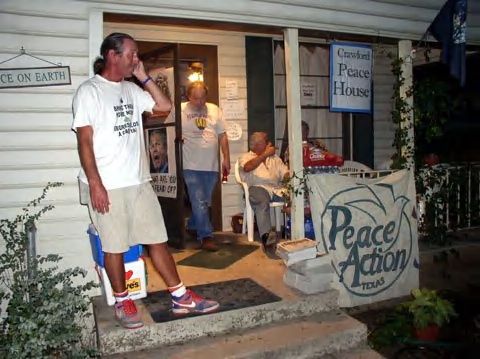
Meeting with Bill Mitchell, GSFP who lost his son, Mike on 04-04-04. I spent a lot of time with Bill, and we learned we had in common that his son was in 1st Armored and my 2 are in 1st Armored. Bill lost his son, Mike on same day Cindy lost her son, Casey. My 2 were extended with the 1st Armored, the first division to be extended, as a direct result of the uprising at Sadr City where Bill and Cindy lost their sons. It was an eerie revelation to learn. Bill Mitchell is an amazing human being and we became friends for the week I was there.  Posted by Picasa
Read more

Friday, June 24, 2005

Some 1st Armored Division units could deploy to Iraq sooner than expected

By Jessica Inigo, Stars and Stripes

European edition, Wednesday, June 22, 2005


Major units within the 1st Armored Division could be headed to Iraq earlier than expected.


In January, soldiers received an official e-mail from 1st AD headquarters telling them to expect to deploy between Nov. 1, 2005 and January 2006.


But 1st AD spokesman Maj. Michael Indovina said Tuesday that the 2nd Brigade Combat Team from Baumholder, Germany, now expects to deploy “in the fall,” which he described as anytime between September and November. That could be up to two months earlier than previously reported.


However V Corps officials say the news should come as no surprise to the troops.


“I honestly don’t know what each and every company was told,” said Hilde Patton, V Corps spokeswoman. “I just know in the overall window — we expected to have units leave within April and January.”


A Pentagon release in February listed Europe-based units that would deploy to Iraq, Afghanistan or Africa between April and January 2006. However, no 1st AD units were on that list.


Another unit not on the list, the 1st Military Intelligence Battalion from Wiesbaden, left for Iraq last week.


The unit left “early,” Patton said, because they had been home for 10 months, not the full year most units get after a deployment.


“It’s not always just because they’re leaving within the window time frame. It’s a combination of other factors,” she said.


Outside of the previously announced units headed downrange in the coming months, a new unit has been added to the mix, Indovina said.


A handful of air traffic controllers with the 3rd Battalion, 58th Aviation Regiment, Air Traffic Services out of Giebelstadt, Germany, who were not previously slotted for deployment will be leaving for Afghanistan soon, he said.


“Things change every day,” Indovina said about the addition to the deployment rotation.


The troops will remain downrange “until the mission ends.”


Right now, this does not look like a full year, but that could change, according to Indovina.


Indovina said the 2nd BCT is currently on block leave and will come home to predeployment exercises at the U.S. Army Combat Maneuver Training Center in Hohenfels, Germany, in late summer.


CMTC provides realistic training for soldiers and units on their way downrange.


The 2nd BCT was activated Thursday. The division is now fully operational and ready to deploy as of Tuesday, he said.


The 1st Brigade Combat Team, from Friedberg, will hold its activation ceremony June 30, Indovina said.


from European and Pacific Stars & Stripes

European and Pacific Stars & Stripes
Read more

Monday, May 2, 2005

Learned yesterday that my sil's unit was briefed on their redeployment to Iraq (2nd for him) and were told that Rumsfeld to be visiting their unit (Germany). I am not sure when he will visit nor how many unit(s) will be included to hear Rumsfeld's encouraging support message. Unit was given this admonishment however;

'Do not ask Rumsfeld about uparmored humvees on threat of an Article 15'


Why not? It's public knowledge there are production problems with getting the troops the uparmored humvees; it's public knowledge the question was already asked of Rumsfeld months ago by a soldier in the field; it's public knowledge the President responded that we need to do all we can to get the troops the protection they need; it's public knowledge that production of uparmored humvees is being done by only 1 company; it's public knowledge that production has not improved since that question was put to Rumsfeld.

Since my sil (and all of his unit + the other units of 1st Armored) has orders to redeploy to Iraq and is Stop Lossed, and situation in Iraq is worsening, what more logical question could they ask than what kind of equipment they will have during combat?

Read more

Saturday, January 22, 2005

He's going back to Iraq, 2nd Deployment + Stop Loss

had hoped to retire this blog, it served it's function at the time, yet, I have not lived easily knowing that the potential for another Bush administration was a possibility. While with every fiber of my soul and being, I worked against such an outcome, knowing it would mean more war in Iraq, more war in other countries, it looks like we have four more years with Bush at the controls. My kids, who already served in Iraq, will be sent again, I feared, and this blog has not yet seen it's end time.


I left it, rather unattended, to serve as a placemark and prayed never have to pick it up again and resume entries into this blog. It is a tragedy that I have to keep it going, as my loved ones are being sent back to Iraq for 2nd deployments.


My dear son-in-law, the mainstay and backbone of his family which are my daughter and their three children, my grandchildren....he's just received orders for redeployment to Iraq. On top of a second deployment, he also now is under Stop Loss orders. He was due to have his enlistment completed in 2005 and now with Stop Loss he would not be able to get out of military as scheduled. He has already served in Iraq 2003-2004 in a 15 month tour, 1st Armored, and was caught up as was all of the 1st Armored troops in a last-minute extension in April 04, at exactly the time he was scheduled to come home. NOT. Another three months in Iraq.


His cousin, my nephew, is awaiting orders now and is himself a husband, a father and they are expecting their second child. He also served 15 months in Iraq, 1st Armored, and was extended at same time as my son-in-law. He has served previously in Bosnia. He is awaitng his own orders for a 2nd tour in Iraq. Another tour in Iraq, and this is more war and combat than a young person should have to see or bear.


Both will do their mission, and I do not speak for them but I do speak up on their behalf and not necessarily with their permission yet they do know I have been doing all in my limited power as a military family, a mother, a civilian, to do what I can to halt the carnage and destruction that are the features of collateral damage, words used so impersonally to describe the stink and death of war.


What is appalling besides everything about how the troops needs are under-met, and how badly they are being exploited is that his choices now look like this:


Re-enlist in March. No, you don't want to re-enlist? Well you already have orders to redeploy to Iraq and you are already under Stop Loss orders so you won't be getting out any time soon anyway. If you don't re-enlist, you'll be serving anyway and in Iraq, while the rest of the guys get their bonus for re-enlisting, you won't be getting yours and will be serving beside them anyway.


What limited choices are these and does our public know that the all-volunteer military has fallen through trickery and deceit, misleading to even false information into an entrapment. They can't get out! That, friends, is a long way from "volunteer".


The troops cannot be recycled over and over again to Iraq without grotesque expense to themselves and their families which seemingly, if I am to judge by the civilian response in our country, is just fine so long as no one else in our country but the military families and troops have to bear the burden. That argument, "well they volunteered didn't they" doesn't carry water anymore. It may have started out that way, but so much has changed along the course, that this is a long, long way from anything resembling an "all volunteer military".


Not unlike the Iraqis themselves, our troops are trapped in a war-torn country in a war ordered and sustained by our own government and seemingly a majority of this country's citizens. Please, please tell me, WHAT is the reason now?


Having lived through almost 3 years of lies and deception spouted by the administration, I have endured listening to the citizens catch hold of propaganda and repeat it ad-nauseum with little thought to the words they are gleefully repeating . I have seen our mainstream news turn itself away from it's origins as news reporting to become more of the propaganda, lies, deception and treachery which keeps our kids (and our old men hauled back into active duty) in Iraq. But one by one the lies have come to light, yet our citizenry champions the newest and latest excuses for why we are there and why the troops must stay.


I had hoped to retire this blog when my son-in-law and nephew came home from Iraq. I built it only to give them a record to look at when they returned. Now they will be returning to Iraq in second deployments, in large part, thanks to the deliberate ignorance and willfulness of our own citizenry, my fellow countrymen, my neighbors. I do not thank you or excuse you for your part in casting the death warrant vote but I also know the singular accountability and responsibility lies at the hands of our own President and Commander-in-Chief, George W. Bush.


So picking up where this blog left off, I will be recording again the conditions in our country, in our politics, in our citizen mindset, as our two loved ones are marched back to Iraq. To those so willing for this war, and the wars yet coming, as promised by the President in his Inauguration speech, I say, send your own if you are so committed to this man you cheer as your President, and bring mine home.


Operation Catch Up
Read more

Tuesday, September 7, 2004

Time Slow to Heal Pain Left by Soldier's Death

Released SEPTEMBER 1, 2004

washingtonpost.com

For Va. Family, Perpetual Days Of Anguish Time Slow to Heal Pain Left by Soldier's Death

By Sue Anne Pressley

Washington Post Staff Writer

Tuesday, September 7, 2004


That Friday morning in November, when Donna Gilmore heard the news reports that a U.S. Army helicopter had been shot down in Iraq, her heart ached to think what the families of the dead soldiers would be going through. As she waited inside her Stafford, Va., church, ready to leave for an out-of-town conference, she and her minister decided to pray.


"We prayed for the families," Gilmore said, "not knowing it was my own family I was praying for."


That was the beginning, Day One.


In a few hours, Gilmore would learn that her husband of 21 years and the father of her two college-age children had been aboard the Black Hawk UH-60 helicopter that crashed Nov. 7 in Tikrit, killing all six aboard. Army Command Sgt. Maj. Cornell W. Gilmore, 45, had been in Iraq just five days, for what amounted to a routine inspection tour. He was supposed to be gone a week.


More than 16 months after President Bush declared major combat in Iraq over, Gilmore and others are still dying there. Before that declaration, about 140 U.S. troops had died; since, more than 800 have fallen. Publicly, these deaths have prompted a bitter national divide. Privately, they have triggered a much more lasting pain.


The funerals have filled the news -- often young soldiers in the military a short time. Cornell Gilmore was different. He and his family had lived the military life for more than 20 years, and they knew, as his wife said, that "anyone in uniform is in jeopardy." He had fought on the front lines in the Persian Gulf War in 1991. But his family members had believed that in this conflict he was well-removed from danger, and now they are trying to reconcile their deep loyalty to the military with their sorrow over his death.


For this family and others, the experience is a struggle through time. Day One is one of the worst days, when the anguish is fresh and scalding. But there are many more bad days to come, a round of birthdays and anniversaries and holidays and ordinary times that will never be the same again, that stretch far beyond the funeral services and the surge of public attention.


Donna Gilmore, 43, and her children, Dawnita, 20, and Cornell II, or C.J., 18, have been navigating this altered life for almost 10 months. A close family who had lived on bases from Kansas to Germany to Hawaii, they are learning, as the days and months pass, to go on without their father and husband, their "team leader."


"I have had moments when I've been here by myself that have just been horrible, and you just cry out to God," Donna Gilmore said.


But "C.J. said something to me early on. He said, 'Mom, we're never going to get over this -- we just have to get on with life.' "


A Man of Big Smiles


Cornell "Gil" Gilmore, a tall, broad-shouldered man, would enter a room with a big smile and one of his signature lines, delivered with exclamation points. "Greetings, everyone! How are you?"

He had other phrases he liked to use, so closely identified with him that they were included on the back cover of his funeral program: "Come on, team!" "I got you covered." And his exit line, "Go forth -- and have a nice day."


He was known for his optimism, his love of baseball and gospel music, and his cookie habit. He believed in "life lessons" and being punctual. He went out every Friday night on a scheduled date with his wife, getting dressed up and enduring his children's taunts. He was tight with a dollar and loved his collection of cheap clunker cars, especially "The Blue Bomb," an old Chevrolet he took C.J. out in for father-son talks.


The youngest of 12 children who grew up in Baltimore, he had become the highest-ranking enlisted man and the highest-ranking African American in the Army's Judge Advocate General's Corps. But he had vowed that when he retired in a few years, he was going to be a Wal-Mart greeter.


"He meant it," said Dawnita, a junior at Johnson C. Smith University in Charlotte and a self-described "daddy's girl," who resembles her father. "My dad had worked very hard, and he was going to be a greeter -- he said he did that already."


He had joined the Army in 1981, after graduating from the University of Maryland at Baltimore. When he announced his plans to Donna, then his fiancee, she had no idea what military life would be like, but she was ready to give it a try. Dawnita was born on a memorably hot Fourth of July in Fort Polk, La.; C.J., 15 months later, when the family was posted to Germany.


An involved father, Gilmore coached youth teams in every sport. Church was important. As a skilled pianist, drummer, bass player and singer, he always took the lead in worship services, and for a time, he and the children formed a gospel group called G-3, which stood for both Gilmore 3 and God's 3. Donna and Cornell also had what they called "a marriage ministry," teaching a course on improving relationships to other couples.


Military life suited them. Gilmore advanced steadily, lauded for his leadership skills, sunny personality and kindness toward junior soldiers. The family made close friends wherever they lived, and although they joked that no one joined the military to get rich, it was for them a satisfying experience.


In 2002, Gilmore was transferred to the Pentagon, on what he planned as his final assignment. For the first time, the family was back in their home area in a position to buy a house. They chose a two-story model on a corner lot in Stafford. The kids were off at college. Evenings when they were free, Donna and Cornell would sit in their matching recliners, up in the loft of their new home, and talk.


The Pentagon job, unlike his previous posts, required a lot of traveling. When he telephoned his wife from London in early November, en route to Iraq, he reported with a laugh that his luggage had been lost.


Day One


Donna Gilmore was aboard the church bus, headed to a women's conference in Williamsburg later that awful Friday morning in November, when her cell phone rang. A friend in Fort Stewart, Ga., another military wife, had heard the ranks of the six helicopter-crash victims in Iraq. One was a regimental sergeant major in the JAG Corps. That could be only one person.


Gilmore telephoned the Pentagon. "I kind of forced the hand," she said. "I said, 'Look, I can't wait till I get home to have somebody tell me this news. I need to know now.' "


Finally, an officer told her, reluctantly, that they believed her husband had been involved in an incident.


The bus was already stopped in a parking lot.


"There was a clear sky, and I remember a field, and I didn't want anybody to touch me. I just wanted to go out and talk to God," Gilmore said. "And I remember I was crying and talking to him at the same time, 'Okay, God, you got me. You're going to have to have me because I don't know what else to do.'


"And I remember the second thing that came to my mind -- 'I've got to get to my children before they hear about this on the news.' "


Dawnita, at school in Charlotte, had awakened that morning, thinking about helicopters and wondering why such strange things would pop into her head. When her mother called, "I broke down," she said. "I just fell on the floor and I was crying like crazy."


Her boyfriend and other friends arrived and helped her pack her things. Outside the dorm, they joined hands in a circle and prayed. "The next thing I know, two carloads of us were heading out," she said.


C.J., who was a freshman at St. Augustine's College in Raleigh, N.C., was worried about writing a paper in the hour left before speech class when his mother reached him about noon.


"She told me there had been a helicopter crash," he said. "I thought, 'Okay, my dad's coming back with one arm.' Death was far away from my mind. I said, 'What happened?' and she said, 'He died,' and I just lost it. I was angry. My fists were balled up, and I was ready to hit something, but of course, I didn't."


The next days passed in a blur of activity. There was the funeral to prepare for, a home-going service, as the family called it. The house was full of people. The family kept up a stoic front.


"I never ever that whole week cried in front of anybody. I waited until I'd go to bed," Dawnita said. "I'd have people come up to me and say, 'You're so strong, you're being so strong for your mom,' but you know, you do what you have to do. I kept myself busy."


C.J. was determined to stick by his mother. "When I went in the house, something hit me and I kind of closed up," he said. "I was making sure my mother was okay. I didn't have to worry so much about my sister because her boyfriend was there, and I was happy for that. I was looking out for my mother."


Long ago, in that thorough way of his, Cornell had explained to his wife what would happen should he be killed on duty. Army representatives were waiting for her when she returned home, and a casualty assistance officer was assigned to help make funeral arrangements and take care of bureaucratic chores. Baskets of sympathy cards arrived from soldiers around the world who had been inspired by Cornell.


The home-going service at Shiloh Christian Church in Stafford drew 2,000 people. Dawnita led a 300-person choir; C.J. accompanied on the piano. Donna was proud of her children, standing before so many people, speaking so movingly about their dad.


Ten days after their father died, they were both back at school.

"There was no choice," their mother said. "Cornell and I, we both always said, 'We're raising you guys to leave us.' I could've gotten real selfish and said, 'Look, I need my kids home.' But I couldn't do that. Their father would not have been pleased with that. They have their lives to live, and I have mine, whatever this new life is going to be."


C.J. had been particularly reluctant to go. Donna looked at her big, tall son, the star football player who played the piano with such feeling, and felt that she needed to release him somehow. During the past week, she had watched as well-meaning people patted him on the back and told him that he was "the man" now.


"I never wanted him to feel that kind of pressure," she said. "I told him, 'You'll never be the man of this house -- you'll always be the son of this house. But you're going to be the man of your own house someday.' "


Finally, she sent her best friend home, the friend who had reached her on the bus and driven 15 hours from Georgia to be with her, who illustrated how the bonds of military life sometimes were as strong as blood.


"She wasn't going to leave until I told her, 'You've got to get back to your family,' " Donna said. "And after she left, I remember being here by myself, and I sat up in that loft in my husband's chair and his blanket, and I slept in that chair all night."


Painful Reminders


Then there was a flurry of special days to get through, each one a numbing yet painful experience: Thanksgiving, the Gilmore's wedding anniversary on Dec. 4, what would have been Cornell's 46th birthday four days later, the first Christmas without him.


Thanksgivings had been huge, all those years on the military bases. Donna would cook for days, and Cornell would invite everyone they knew, as many as 60 people. Before they ate, he would make everyone hold hands and name something they were thankful for. Afterward, he would organize a Thanksgiving talent show. This time, the three Gilmores wearily visited relatives in Baltimore; Donna did not feel like cooking.


Sometimes, she could not help but wonder why things had happened this way, why her husband had to leave at such a prime time in their lives. She knew, she said, that "God's timing is his timing." But she still found herself counting the days of her new life as a widow, every day a small victory because she got through it.


She was thankful he had been so thrifty. With his pension, insurance and savings and her salary as a personnel security specialist, they would keep the house, and the children would remain in school. "He had his ducks in a row," she said. "It made it easier -- not easy, but easier."


But there were so many things to break her heart all over again. After her husband died, Donna learned that he had made plans for their wedding anniversary -- they had reservations for a long weekend in early December in Ocean City.


It hurt to know that his dog tags were lost, but a military friend in Korea had a special set made for her that she wore all the time. She would listen to Cornell's voice on the family answering machine -- "Greetings, everyone!" -- or hold the plaque he had given her the week before he left -- "Happiness is being married to your best friend" -- and the loneliness was bone-crushing.


"I don't know how anyone gets through this who doesn't have faith in God," she said.


The day of her anniversary -- Day 28 -- C.J.'s choral group was performing at school, and Donna decided to drive down to Raleigh to see him, declining friends' offers to accompany her. "It was kind of healing," she said. "I just talked to God and talked to my husband, all the way down to Raleigh and back."


C.J., aware of the day's significance, invited his mother on stage and gave her a bouquet of flowers. It was a lovely moment, Donna said, but there was always a downside. "Then you come home and you just crash," she said.


At college, her children also were feeling their way.


"When I got back to school, I was still at Day One," C.J. said. "I always felt at Day One. I mean, nothing was progressing. I actually talked to my favorite teacher -- I was ready to give up music and where I was going with my life. I wasn't sure if I was doing it for my father because I knew he would like it or if I was doing it because I loved music. I just had to stop and think."


One thing he knew for sure: Some of his happiest memories were of being with his dad in the empty church before choir practice on Saturday mornings, the two of them, working on their music.


Military Bonds


Day 82, in late January, found Donna Gilmore on a trip to Lacey, Wash., to the family's most recent post before the Pentagon, Fort Lewis. She and Cornell had been involved in a group that encouraged young African Americans to go to college, and she was invited back for a scholarship program and a tribute to her husband. She was able to be there, she said, "and not cry buckets of tears" only because she knew Cornell was now at "his permanent duty station."


Her ties to the military felt as strong as ever. Each time she heard of a new death in Iraq, she felt a stab of pain. When Pfc. Jerrick M. Petty, 25, of Idaho, whom she did not know, was killed Dec. 10, she wrote a message to his family on a commemorative Web site: "I know your heart hurts so much that at times it seems unbearable," she wrote. "Take heart, unfortunately there are a lot of us here who are personally going through the same thing."


But a dark thought sometimes filled her head.


"The one thing that angers me about everything is that probably, if the war had never been declared over, Cornell wouldn't have been over there," she said. "They wouldn't have had that type of inspection he was doing if we were still at war. "


Death, of course, is a prospect for any military family, the unspoken reality they all have to live with. Her husband had served in the 1st Armored Division in Desert Storm, but that conflict "had a totally different feel -- we didn't have the casualties," she said. In his position with the JAG Corps, the group that oversees the Army's courts and legal affairs, he had seemed safe from the current dangers.


"You hate to compare it to Vietnam," she said, " . . . but it seems to me we're a few little people in a big country that doesn't belong to us, where we can't tell sometimes who the enemy is."


Beyond that, the Gilmores are reluctant to criticize the military or the government. Donna said that although she will always "love the soldiers and their families, the military bureaucracy is what it is." Looking forward to voting in her first presidential election, Dawnita would not say which candidate she supports, only that everyone "should be sure to vote."


The fifth and sixth months passed, and Donna switched from counting days without her husband to counting months. C.J. decided to stick with his music after all; Dawnita seemed on a steady course. Cards still arrived from soldiers and their families. Reports of more military deaths in Iraq continued to lead the news.


Fridays, their old date night and the day on which he died, were still hard; Sundays, too, "because we lived in church." It was hard to hear her brothers-in-law speak on the telephone -- they sounded so much like Cornell, it made her catch her breath. She never knew when something would hit her like that: Just a few weeks ago, as she sat in her hairdresser's shop, Stevie Wonder came on the radio, singing "Ribbon in the Sky," one of the couple's special songs, and she had to leave the room quickly to break down in private.


She still talked to him. She thought about how she used to chide him for sneaking too many cookies, concerned for his health. "But now I tell him, 'Honey, I wish I could give you all the cookies you wanted right now.' "

Gradually, it became easier for the three family members to talk about him with other people, to sit and laugh and sometimes cry a little, surrounded by his photographs. There was still "a crash" afterward, they said, but it was not quite as devastating. They were sure sometimes they could hear him telling them to "come on, team!"


"Dad was not a bitter person -- the person I remember was the epitome of happiness," Dawnita said. "So why would I have a horrible life after this? Because you know, all there is left to do is stay focused on God's work . . . and number two, do everything Dad taught me.


"And like he always said," and here she paused and her mother and brother joined in to chant in unison Sgt. Maj. Gilmore's famous exit line: "Go forth -- and have a nice day."


© 2004 The Washington Post Company


there was no url to provide, article is by subscription


(In accordance with Title 17 U.S.C. Section 107, this material is distributed without profit to those who have expressed a prior interest in receiving the included information for research and educational purposes. t r u t h o u t has no affiliation whatsoever with the originator of this article nor is t r u t h o u t endorsed or sponsored by the originator.)

Read more

Monday, September 6, 2004

To Whom it May Concern

By Brooke M. Campbell

Friday 03 September 2004


To Whom it May Concern,


I found out that my brother, Sergeant Ryan M. Campbell, was dead during a graduate seminar at Emory University on April 29, 2004. Immediately after a uniformed officer knocked at my mother's door to deliver the message that broke her heart, she called me on my cell phone. She could say nothing but "He's gone." I could say nothing but "No." Over and over again we chanted this refrain to each other over the phone as I made my way across the country to hold her as she wept.


I had made the very same trip in February, cutting classes to spend my brother's two weeks' leave from Baghdad with him. Little did I know then that the next time I saw him would be at Arlington National Cemetery. During those days in February, my brother shared with me his fear, his disillusionment, and his anger. "We had all been led to believe that Iraq posed a serious threat to America as well as its surrounding nations," he said. "We invaded expecting to find weapons of mass destruction and a much more prepared and well-trained Republican Guard waiting for us. It is now a year later, and alas, no weapons of mass destruction or any other real threat, for that matter."


Ryan was scheduled to complete his one-year assignment to Iraq on April 25. But on April 11, he emailed me to let me know not to expect him in Atlanta for a May visit, because his tour of duty had been involuntarily extended. "Just do me one big favor, ok?" he wrote. "Don't vote for Bush. No. Just don't do it. I would not be happy with you."


Last night, I listened to George W. Bush's live, televised speech at the Republican National Convention. He spoke to me and my family when he announced, "I have met with parents and wives and husbands who have received a folded flag, and said a final goodbye to a soldier they loved. I am awed that so many have used those meetings to say that I am in their prayers and to offer encouragement to me. Where does strength like that come from? How can people so burdened with sorrow also feel such pride? It is because they know their loved one was last seen doing good. Because they know that liberty was precious to the one they lost. And in those military families, I have seen the character of a great nation: decent, and idealistic, and strong."


This is my reply: Mr. President, I know that you probably still "don't do body counts," so you may not know that almost one thousand U.S. troops have died doing what you told them they had to do to protect America. Ryan was Number 832. Liberty was, indeed, precious to the one I lost-- so precious that he would rather have gone to prison than back to Iraq in February. Like you, I don't know where the strength for "such pride" on the part of people "so burdened with sorrow" comes from; maybe I spent it all holding my mother as she wept. I last saw my loved one at the Kansas City airport, staring after me as I walked away. I could see April 29 written on his sad, sand-chapped and sunburned face. I could see that he desperately wanted to believe that if he died, it would be while "doing good," as you put it. He wanted us to be able to be proud of him. Mr. President, you gave me and my mother a folded flag instead of the beautiful boy who called us "Moms" and "Brookster." But worse than that, you sold my little brother a bill of goods. Not only did you cheat him of a long meaningful life, but you cheated him of a meaningful death. You are in my prayers, Mr. President, because I think that you need them more than anyone on the face of the planet. But you will never get my vote.


So to whom it may concern: Don't vote for Bush. No. Just don't do it. I would not be happy with you.


Sincerely, Brooke M. Campbell Atlanta, GA


Kirksville, Missouri - A soldier from northeast Missouri was among eight killed April 29, 2004, in a car bombing in Iraq, the U.S. Department of Defense said Monday.


Sergeant Ryan M. Campbell, 25, of Kirksville, was a member of the Army's 4th Battalion, 27th Field Artillery Regiment, 1st Armored Division.


The soldiers were removing roadside bombs from a highway south of Baghdad. Campbell's mother, Mary Ann MacCombie of Kirksville, said the unit intercepted a station wagon crammed with 500 pounds of ammunition, and the driver detonated an explosive.


Campbell was stationed in Germany before he was sent to Iraq. He originally had been expected to return to the United States in April, but his duty in Iraq was extended three months.


"He's supposed to be home now," said MacCombie, recalling that her son called twice Wednesday, a day before he died. "His last words were, 'I'll be back in July.'"


Campbell joined the National Guard along with his best friend, Brendan McEvoy, several years ago. The pair enlisted in the Army in February 2002.


MacCombie said Campbell was an avid outdoorsman and a talented drummer who tried to assemble a band during his time in Germany. He graduated from Truman State University in Kirksville and planned to attend graduate school after completing his military service.


A memorial service will be Friday at Mary Immaculate Catholic Church in Kirksville. A specific time has not been set. Campbell will be buried at Arlington National Cemetery.


Other soldiers killed in the attack were

Staff Sergeant Esau G. Patterson Jr., 25, of Ridgeland, South Carolina;


Staff Sergeant Jeffrey F. Dayton, 27, of Caledonia, Mississippi;


Specialist James L. Beckstrand, 27, of Escondido, California;


Specialist Justin B. Schmidt, 23, of Bradenton, Florida;


Private First Class Ryan E. Reed, 20, of Colorado Springs, Colorado;


Private First Class Norman Darling, 29, of Middleboro, Massachusetts;


and Private First Class Jeremy Ricardo Ewing, 22, of Miami, Florida.


Campbell, Ryan Montgomery SGT US Army Veteran Service Dates: February 2002 - April 2004 Date of Birth: 11/07/1978 Date of Death: 04/29/2004 Date of Internment: 05/11/2004 Buried at: Section 60 Site 7979 - Arlington National Cemetery


http://www.truthout.org/docs_04/090604A.shtml

Read more

Hydrangea

Hydrangea

Dahlia

Dahlia

spring color bowl

spring color bowl

  © Blog Design by Simply Fabulous Blogger Templates

Back to TOP