Showing posts with label armor inadequate. Show all posts

Thursday, January 29, 2009

Suicides, electrical shocks, deficient body armor plague U.S. troops


GI Suicides in 2008 Highest on Record

The Army is expected to release a report later today revealing the highest number of suicides among troops in nearly three decades, according to CNN.

The network reported this morning that the Army will confirm 128 suicides in 2008, along with 15 suspected suicides currently under investigation among active-duty Soldiers and activated National Guard and Army Reserve troops. The Army also will announce a study of Soldier suicides and links to post-combat stress, CNN says.

read more at Military.com


Army Report Notes 231 Shock Incidents

U.S. troops in Iraq suffered electrical shocks about every three days in a two-year period surrounding the electrocution death of a Green Beret sergeant, according to an internal Defense Contract Management Agency report obtained by the Tribune-Review.

The 45-page document -- a high-level request for corrective action generated last fall -- found that Texas-based military contractor KBR Inc. failed to properly ground and bond its electrical systems, which contributed to Soldiers "receiving shocks in KBR-maintained facilities on average once every three days since data was available in Sept. 2006."

The agency determined that KBR "failed to meet basic requirements to identify life-threatening conditions on tanks, water pumps, electrical outlets and electrical panels."

The report adds that government search results of a KBR-maintained database revealed that 231 electrical-shock incidents occurred in the period from September 2006 through July 31, 2008 -- indicating that the activity continued long after the death of Sgt. Ryan Maseth, 24, who suffered cardiac arrest after stepping into his Baghdad shower on Jan. 2, 2008.

Records show Maseth was electrocuted when he turned on the water that flowed through metal pipes. The Army Criminal Investigation Division recently determined Maseth's death was negligent homicide, rather than an accident as previously reported.

read more at Military.com


Body Armor Recalled by Army

WASHINGTON - Army Secretary Pete Geren has ordered the recall of more than 16,000 sets of body armor following an audit that concluded the bullet-blocking plates in the vests failed testing and may not provide Soldiers with adequate protection.

The audit by the office of the Defense Department  inspector general, not yet made public but obtained by The Associated Press, faults the Army for flawed testing procedures before awarding a contract for the armor.

In a letter dated Jan. 27 to Acting Inspector General Gordon Heddell, Geren said he did not agree that the plates failed the testing or that Soldiers were issued deficient gear. He said his opinion was backed by the Pentagon’s top testing director.

Despite his insistence that the armor was not deficient, Geren said he was recalling the sets as a precaution.

Geren also said he's asked for a senior Pentagon official to resolve the disagreement between the Army and the inspector general's office.

read more at Military.com

Read more

Sunday, January 8, 2006

Pentagon Study Links Fatalities to Body Armor - New York Times

posting the entire article here via educational public information. 80 % avoidable fatalities for wounded Marines in Iraq. This is no small disclosure, and if you feel the outrage act; link to enter your zip code and readily access your elected officials. Call your congressperson


Pentagon Study Links Fatalities to Body Armor - New York Times:
January 7, 2006

By MICHAEL MOSS

A secret Pentagon study has found that as many as 80 percent of the marines who have been killed in Iraq from wounds to the upper body could have survived if they had had extra body armor. Such armor has been available since 2003, but until recently the Pentagon has largely declined to supply it to troops despite calls from the field for additional protection, according to military officials.

The ceramic plates in vests now worn by the majority of troops in Iraq cover only some of the chest and back. In at least 74 of the 93 fatal wounds that were analyzed in the Pentagon study of marines from March 2003 through June 2005, bullets and shrapnel struck the marines' shoulders, sides or areas of the torso where the plates do not reach.

Thirty-one of the deadly wounds struck the chest or back so close to the plates that simply enlarging the existing shields "would have had the potential to alter the fatal outcome," according to the study, which was obtained by The New York Times.

For the first time, the study by the military's medical examiner shows the cost in lives from inadequate armor, even as the Pentagon continues to publicly defend its protection of the troops.

Officials have said they are shipping the best armor to Iraq as quickly as possible. At the same time, they have maintained that it is impossible to shield forces from the increasingly powerful improvised explosive devices used by insurgents in Iraq. Yet the Pentagon's own study reveals the equally lethal threat of bullets.

The vulnerability of the military's body armor has been known since the start of the war, and is part of a series of problems that have surrounded the protection of American troops. Still, the Marine Corps did not begin buying additional plates to cover the sides of their troops until September, when it ordered 28,800 sets, Marine officials acknowledge.

The Army, which has the largest force in Iraq, is still deciding what to purchase, according to Army procurement officials. They said the Army was deciding among various sizes of plates to give its 130,000 soldiers, adding that they hoped to issue contracts this month.

Additional forensic studies by the Armed Forces Medical Examiner's unit that were obtained by The Times indicate that about 340 American troops have died solely from torso wounds.

Military officials said they had originally decided against using the extra plates because they were concerned they added too much weight to the vests or constricted the movement of soldiers. Marine Corps officials said the findings of the Pentagon study caused field commanders to override those concerns in the interest of greater protection.

"As the information became more prevalent and aware to everybody that in fact these were casualty sites that they needed to be worried about, then people were much more willing to accept that weight on their body," said Maj. Wendell Leimbach, a body armor specialist with Marine Corps Systems Command, the corps procurement unit.

The Pentagon has been collecting the data on wounds since the beginning of the war in March 2003 in part to determine the effectiveness of body armor. The military's medical examiner, Dr. Craig T. Mallak, told a military panel in 2003 that the information "screams to be published." But it would take nearly two years.

The Marine Corps said it asked for the data in August 2004; but it needed to pay the medical examiner $107,000 to have the data analyzed. Marine officials said financing and other delays had resulted in the study's not starting until December 2004. It finally began receiving the information by June 2005. The shortfalls in bulletproof vests are just one of the armor problems the Pentagon continues to struggle with as the war in Iraq approaches the three-year mark, The Times has found in a continuing examination of the military procurement system.

The production of a new armored truck called the Cougar, which military officials said had so far withstood every insurgent attack, has fallen three months behind schedule. The small company making the truck has been beset by a host of production and legal problems.

Meanwhile, the Pentagon is still relying on another small factory in Ohio to armor all of the military's principal transport trucks, the Humvee, and it remains backlogged with orders. The factory, owned by Armor Holdings, increased production in December after reports in The Times about delays drew criticism from Congress. But the Marine Corps said it was still waiting for about 2,000 of these vehicles to replace other Humvees in Iraq that are more lightly armored, and did not expect final delivery until June.

An initiative begun by the Pentagon nearly two years ago to speed up production by having additional companies armor new Humvees remains incomplete, Army officials said.

Body armor has gone through a succession of problems in Iraq. First, there were prolonged shortages of the plates that make the vests bulletproof. Last year, the Pentagon began replacing the plates with a stronger model that is more resistant to certain insurgent attacks.

Almost from the beginning, some soldiers asked for additional protection to stop bullets from slicing through their sides. In the fall of 2003, when troops began hanging their crotch protectors under their arms, the Army's Rapid Equipping Force shipped several hundred plates to protect their sides and shoulders. Individual soldiers and units continued to buy their own sets.

The Army's former acting secretary, Les Brownlee, said in a recent interview that he was shown numerous designs for expanded body armor in 2003, and had instructed his staff to weigh their benefits against the perceived threat without losing sight of the main task: eliminating the shortages of plates for the chest and back.

Army procurement officials said that their efforts to purchase side ceramic plates had been encumbered by the Army's much larger force in Iraq compared with the Marines' and that they wanted to provide manufacturers with detailed specifications. Also, they said their plates would be made to resist the stronger insurgent attacks.

The Marine Corps said it had opted to take the older version of ceramic to speed delivery. As of early last month, officials said marines in Iraq had received 2,200 of the more than 28,000 sets of plates that are being bought at a cost of about $260 each.

Marine officials said they had supplied troops with soft shoulder protection that can repel some shrapnel, but remained concerned that ceramic shoulder plates would be too restrictive. Similarly, they said they believed that the chest and back plates were as large as they could be without unduly limiting the movement of troops.

The Times obtained the three-page Pentagon report after a military advocacy group, Soldiers for the Truth, learned of its existence. The group posted an article about the report on its Web site earlier this week. The Times delayed publication of this article for more than a week until the Pentagon confirmed the authenticity of its report. Pentagon officials declined to discuss details of the wound data, saying it would aid the enemy.

"Our preliminary research suggests that as many as 42 percent of the Marine casualties who died from isolated torso injuries could have been prevented with improved protection in the areas surrounding the plated areas of the vest," the study concludes. An additional 23 percent might have been saved with side plates that extend below the arms, while 15 percent more could have benefited from shoulder plates, the report says.

In all, 526 marines have been killed in combat in Iraq. A total of 1,706 American troops have died in combat there. The findings and other research by military pathologists suggests that an analysis of all combat deaths in Iraq, including those of Army troops, would show that 300 or more lives might have been saved with improved body armor.

Military officials and contractors said the Pentagon's procurement troubles had stemmed in part from miscalculations that underestimated the strength of the insurgency, and from years of cost-cutting that left some armoring companies on the brink of collapse as they waited for new orders.

To help defeat roadside ambushes, the military in May 2005 contracted to buy 122 Cougars whose special V-shaped hull helps deflect roadside bombs, military officials said. But the Pentagon gave the job to a small company in South Carolina, Force Protection, that had never mass-produced vehicles. Company officials said a string of blunders had pushed the completion date to this June.

A dozen prototypes shipped to Iraq have been recalled from the field to replace a failing transmission. Steel was cut to the wrong size before the truck's design drawings were perfected. Several managers have left the company.

Company officials said they had also lost time in an interservice skirmish. The Army, which is buying the bulk of the vehicles, asked for its trucks to be delivered before the Marine vehicles, and company officials said that move had upended their production process until the Army agreed to get back in line behind the Marines.

"It is what it is, and we're running as fast as we can to change it," Gordon McGilton, the company's chief executive, said in an interview at its plant in Ladson, S.C.

On July 5, two former employees brought a federal false-claims case that accuses Force Protection of falsifying records to cover up defective workmanship. They allege that the actions "compromise the immediate and long-term integrity of the vehicles and result in a deficient product," according to legal documents filed under seal in the United States District Court in Charleston and obtained by The Times.

The legal claim also accuses the company of falsifying records to deceive the military into believing the company could meet the production deadlines. The United States Attorney's office in South Carolina declined to comment on the case. The Marine Corps says the Justice Department did not notify it about the case until December.

Force Protection officials said they had not been made aware of the legal case. They acknowledged making mistakes in rushing to fill the order, but said that there were multiple systems in place to monitor the quality of the trucks, and that they were not aware of any deficiencies that would jeopardize the troops.

Read more

Sunday, October 23, 2005

Colonel quits as troops are denied armoured land rovers in Iraq

THE commanding officer of a battalion serving in Iraq has resigned after failing to obtain armoured Land Rovers for his patrols.


Lieutenant-Colonel Nick Henderson, commander of the 1st Battalion, Coldstream Guards, is understood to have been furious last week after one of his senior sergeants died as a direct result of the failure to supply “armour protected” Land Rovers for his men, defence sources said.


Sergeant Christian Hickey was killed when his vehicle was blown up by a roadside bomb on patrol in Basra late on Tuesday night.


The Ministry of Defence says frontline troops cannot have the armoured Land Rovers because they are not unsuitable for use off-road, but six weeks ago Britain supplied a number of the vehicles to Iraqi police in Basra.


British troops are equipped with the “snatch vehicle”, a Land Rover protected by composite fibre glass designed to stop rifle fire. One senior source who has recently been in Iraq said: “They [the insurgents] have weapons that go right through the composite.”


The source added that British troops were now using tanks or convoys of up to 12 Warrior armoured vehicles to mount patrols with some areas deemed too dangerous to be patrolled at all. “We’re in survival mode right now, we can’t do anything at all,” he said.


The Ministry of Defence insisted that Henderson, 43, decided some time ago to leave but news of his resignation comes amid growing anger among senior officers.


Commanders recently asked for two extra battalions totalling around 1,200 men to help them regain control of Basra but claim the request was denied on political grounds. Instead they were sent one company of fewer than 200 men from the Royal Highland Fusiliers.


Colonel quits as troops are denied armoured land rovers in Iraq - Sunday Times - Times Online
Read more

Friday, August 5, 2005


8/3/2005 By Kimberly Johnson and Bill Nichols, USA TODAY


Marines have placed corrugated armored plates on the outside of the vehicle that are capable of withstanding ammunition of up to .50-caliber. Some Marines are putting sandbags on the floor for added protection.


Improvised explosive attacks against the vehicles occur on almost every operation, according to officers leading an Amtrac company attached to RCT 2.


Since March, the company has lost eight of its 46 Amtracs because of IED attacks, said Marine Capt. Justin Wilhelmsen, executive officer of the unit.


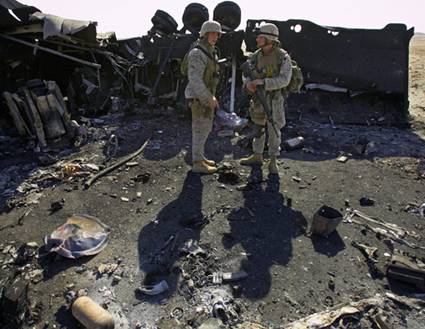
U.S. Marines inspect the remains of a vehicle destroyed by a roadside bomb Wednesday, killing 14 Marines and a civilian interpreter in Barwana, near Haditha, Iraq, Aug. 4, 2005. (AP Photo/Jacob Silberberg) Posted by Picasa
Read more

Tuesday, June 21, 2005

Marine units found to lack equipment -

Over and Over again we keep hearing of equipment shortages for our troops. This equates to life and death for combat troops on the ground, yet their needs continue to go ignored and unfulfilled. Who really has abandoned the troops? Surely this Administration would not deliberately withhold vital, life-saving and needful equipment in it's effort to support our troops deployed by Adminsitrative policies to Iraq. There must be some reasonable explanation for the shortfall. It is unthinkable that there would be deliberateness in not supplying all our troops at a time when our country continues to support this war.....


Investigation concludes shortages of equipment for Marines. We already know about shortages for the Army. Article is slightly long, and you can read at
Marine units found to lack equipment - The Boston Globe - Boston.com - World - News
Read more

Friday, May 6, 2005

Up-Armored 'Gun Trucks' Save Servicemembers' Lives In Iraq

Up-Armored 'Gun Trucks' Save Servicemembers' Lives In Iraq

By Gerry J. Gilmore
American Forces Press Service

WASHINGTON, May 5, 2005 New 5-ton armored "gun trucks" fielded in Iraq are providing U.S. troops with effective protection against insurgents' improvised explosive devices and small-arms fire, a senior military researcher said today on Capitol Hill.

Currently, "there are 31 5-ton gun trucks in Iraq, and they are saving lives," Steven J. DeTeresa, an engineer from the Lawrence Livermore National Laboratory in Livermore, Calif., told members of the House Armed Services Committee.

DeTeresa said the Army used gun trucks during the Vietnam War. The Livermore lab and the Defense Advanced Research Projects Agency, he noted, have worked since December 2003 to jointly develop a modern version of the gun truck concept.

Take a gun truck's standard 5-ton heftiness - heavier than a Humvee -- then add armor and multiweapons capacity -- including hard-hitting .50-caliber machine guns - and you've got "a much more serious convoy protection platform," DeTeresa explained.

DeTeresa cited the experience of a gun truck crew in Iraq that survived an IED explosion, thanks to the truck's two layers of steel armor augmented by ballistic fiberglass.

The gun truck was damaged beyond repair, but "all the crewmembers survived with relatively minor injury," DeTeresa pointed out. The totaled vehicle's armor, he said, was removed and put onto another gun truck.

The fiberglass component of the armor "provides additional protection both from IED threats and small-arms" fire, DeTeresa said.

Gun trucks are also fitted with transparent ballistic glass shields, DeTeresa noted, so gunners can scan for enemy activity while gaining added protection.

Also at the hearing was Lt. Gen. James N. Mattis, head of Marine Corps Combat Development Command at Marine Corps Base, Quantico, Va. Mattis, who commanded Marines in Iraq, noted U.S. troops in Iraq now find "40 to 60 percent of the IEDs before they are detonated."

Added vehicle armor is a good thing for protecting troops in Iraq, Mattis agreed, but he cautioned not to use armor "to encase the soldiers and Marines so well that they cannot see what's going on outside."

see original article at DOD Defense Link

Read more

Monday, May 2, 2005


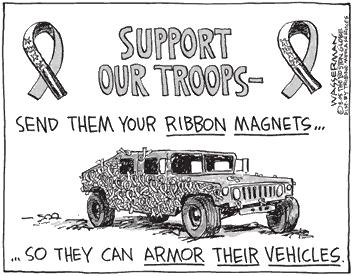
Send them your ribbon magnets, so they can armor their vehicles (sarcasm)  Posted by Hello
Read more
Learned yesterday that my sil's unit was briefed on their redeployment to Iraq (2nd for him) and were told that Rumsfeld to be visiting their unit (Germany). I am not sure when he will visit nor how many unit(s) will be included to hear Rumsfeld's encouraging support message. Unit was given this admonishment however;

'Do not ask Rumsfeld about uparmored humvees on threat of an Article 15'


Why not? It's public knowledge there are production problems with getting the troops the uparmored humvees; it's public knowledge the question was already asked of Rumsfeld months ago by a soldier in the field; it's public knowledge the President responded that we need to do all we can to get the troops the protection they need; it's public knowledge that production of uparmored humvees is being done by only 1 company; it's public knowledge that production has not improved since that question was put to Rumsfeld.

Since my sil (and all of his unit + the other units of 1st Armored) has orders to redeploy to Iraq and is Stop Lossed, and situation in Iraq is worsening, what more logical question could they ask than what kind of equipment they will have during combat?

Read more

Sunday, April 24, 2005

Marines From Iraq Sound Off About Want of Armor and Men

This article from NY Times, is copyrighted so I am not putting the text on this blog, but HIghly Recommending it as a must read article. It is a compelling piece. When the troops speak out and break with the traditional code of silence, there is truth there that we need to hear.


Read the article at The New York Times > International > Middle East > Marines From Iraq Sound Off About Want of Armor and Men
Read more

Friday, April 8, 2005

And still, months later; Where Are The Up-armored humvees; A soldier questions

Article speaks for itself; in December, Rumsfeld is questioned by soldier on lack of up-armored humvees. Now in April, months later, another known death (how many more we don't know about) that could have been prevented with up-armored humvee.


Soldier questions vehicle armor

E-mail mentions death of Kentucky Guardsman


Sen. Mitch McConnell, who received an e-mail from Staff Sgt. Brad Rogers, has asked for an investigation into the claim.


FRANKFORT, Ky. -- Kentucky Army National Guard soldiers in Iraq are being put at risk because their trucks are unreliable, poorly armored and lack protective glass, according to a guardsman stationed in Iraq.


Staff Sgt. Brad Rogers said in e-mails yesterday that Kentucky National Guardsman Sgt. James A. Sherrill might have survived a bomb attack Sunday if his truck had protective glass, known as ballistic windows.


"We have great people and great leadership. I just want answers on why we can't get better equipment with full armor including ballistic windows," Rogers said in an e-mail to The Courier-Journal.


"They need to stop these missions until we get these things."


Kentucky National Guard spokesman David Altom confirmed that Rogers, who belongs to the Paducah-based 2113th Transportation Company, had sent e-mails about the unit's equipment.


Rogers also sent e-mails to friends and coworkers.


The Kentucky National Guard said in a statement that Rogers' claims are being reviewed.


"We have heard about the concerns expressed by a member of the 2113th Transportation Company regarding vehicle safety. The leadership in the Kentucky Guard is conducting an inquiry into the matter, as we still do not have all the details," the statement reads.


"From the time this war began we have continually evaluated and revised our force protection methods. We have done and will continue to do everything in our power to ensure that our soldiers have the very best equipment they can, and that any deficiencies will be corrected as soon as possible," the statement reads.


Adjutant General Donald Storm, commander of the Kentucky Guard, declined to elaborate on the statement until he had investigated the matter further, Altom said.


But at a Tuesday press conference, Storm said vehicles involved in three recent deaths of Kentucky Guardsmen had been armored.


"All of our latest three deaths were either in up-armored Humvees or -- in the case of Sgt. Sherrill -- an add-on armor 915 tractor, which is the equivalent of an up-armored Humvee. It had the latest added-on armor. It had the complete kit."

Regular Army trucks better


Rogers' concerns come after previous complaints from troops in other units.


Some members of a South Carolina-based Army Reserve unit refused in October to go on a convoy mission because they said the trucks lacked armor and were in poor condition.


And Defense Secretary Donald Rumsfeld fielded questions from a Tennessee National Guard soldier in December about why soldiers did not have enough vehicle armor.


Rogers' wife, Sandra Rogers, said he has told her in recent phone calls and e-mails that his unit's trucks are inferior to those used by regular active-duty military units.


"He's not a rookie. He knows the difference between what regular active gets and what they're getting. He's a very reputable man," Sandra Rogers said.


Rogers, 33, of Hebron, called the M915 tractor-trailer truck used by his unit "a dinosaur."


"Most of our vehicles are 22 to 26 years old. Every time we go out on a convoy about 25 percent of the vehicles are breaking down," he said.


Altom said the 2113th is using trucks shipped from Kentucky, and their age "is in their 20s."


Regarding the armor on the trucks, Rogers said it is makeshift.


"The only thing we have is what they call 'hillbilly armor,' which consists of one armor panel on the passenger side and one armor panel on the driver's side."


He said about half the company's trucks are equipped that way while the other half also have an armored floor and back.


"Most everyone, if not everyone, has the ballistic or bulletproof windows that are running our missions to the places we are going. We don't have a single M915 with ballistic windows. I feel in my heart that Sgt. Sherrill would still be with us if he had had ballistic windows."

Death avoidable?


In an e-mail to friends, Rogers said Sherrill's death prompted him to issue his warning, hoping to alert the media and lawmakers.


"I know these things that happen in war. I was in Desert Storm. This didn't have to happen, and this shouldn't have happened," Rogers said of Sherrill's death.


Rogers said the medic who tried to treat Sherrill told him Sherrill was killed by a piece of metal that struck around his left temple.


He added he was not absolutely certain that protective glass could have saved Sherrill.


"I spoke to the medic, the passenger in the vehicle with Sgt. Sherrill, and a couple of others on the convoy, and they tend to believe so. Nothing is certain, but I guarantee it would have slowed it (the shrapnel) down if not stopped it."


Sherrill's father, William Sherrill, said yesterday his 27-year-old son had not complained to him about the trucks.


The elder Sherrill declined to comment on Rogers' warnings. "I realize what you all are trying to do and what he is trying to do -- save more lives. But this is something I just don't want to deal with. There's nothing I can do to bring James back," William Sherrill said.

Lawmakers react


Rogers' e-mails reached the offices of Sens. Mitch McConnell and Jim Bunning and 4th District Rep. Geoff Davis.


Davis spokeswoman Jessica Towhey said Davis voted for a recent supplemental appropriation of $82 billion to fund the war, including upgrades in body armor and vehicle armor.


"We are not in a position to comment (on) what one particular vehicle has versus another vehicle. We are going to defer to the Kentucky adjutant general," she said.


McConnell spokesman Robert Steurer said in a statement the senator has asked the Department of Defense to look into the matter.


Bunning's spokesman, Mike Reynard, said Bunning's office would not comment on the matter until its review of Rogers' claims was complete.

Veteran soldier


Rogers said he began his military career in 1989 on active duty with the Army. He said he served in Korea and later from mid-January to early May of 1991 in Operation Desert Storm.


After leaving active duty he said he joined the Ohio National Guard from late 1991 until late 1996 when he joined the Kentucky Guard.


He said he was transferred within the Kentucky Guard to the 2113th Transportation Company last year.


Sandra Rogers said her husband had told her he had informed his superiors about the e-mails. But she said he emphasized he will continue to always follow orders of his commanders.


The couple have an 8-year-old daughter and a 5-year-old son, Sandra Rogers said.


"I'm not trying to put him on a pedestal, but the community here knows him to be a good man and that when he speaks he's saying the right things."


Soldier questions vehicle armor
Read more

Hydrangea

Hydrangea

Dahlia

Dahlia

spring color bowl

spring color bowl

  © Blog Design by Simply Fabulous Blogger Templates

Back to TOP